Skip to content

Select your region & language

Global

Region

Technical Report: Coefficient representing damping characteristics (3)

4. Summary of relational expressions

The interrelationships of the coefficients representing damping are summarized below.

5. Conclusion

Since vibration is an unavoidable phenomenon when machinery is in operation, keeping vibration below acceptable levels is a crucial point in machine design. In particular, the phenomenon of resonance can cause large vibrations even with small external forces, and requires careful attention. Ideally, the resonant frequency (natural frequency) and the frequency of forced vibration should be separated, but in reality, the natural frequency often falls within the operating range, which is a headache for designers.

As explained in this paper, the behavior of resonance changes significantly with damping. Therefore, it is possible to design systems that suppress vibrations to below acceptable levels by incorporating appropriate damping in advance. Furthermore, when reducing vibrations in problematic machinery or structures, it is common practice to add damping elements such as dampers. In such cases, the knowledge of damping explained in this paper is fundamental. The vibration model discussed here is a simple one-degree-of-freedom system with a sinusoidal external force, but actual machinery and structures are much more complex systems, and the external forces have irregular waveforms. Also, the value of the damping ratio can change depending on the amplitude and state, making actual vibration analysis difficult. However, the basics of mechanical vibration are based on the one-degree-of-freedom system model explained here, and the approximate behavior of vibrations can often be explained by the knowledge explained in this paper, so it should serve as a starting point when considering analysis and countermeasures.

The above provides a brief explanation of the meaning and calculation of coefficients representing damping, focusing on the damping ratio. While the content of this article is common knowledge for designers of machinery and structures, we hope it will be helpful to those who are not vibration specialists when considering vibration countermeasures.

[Supplement] Derivation of the formula for the half-width method

The equation for maximum amplitude (22) can be obtained by substituting the equation for resonant frequency into the equation for amplitude magnification (21).
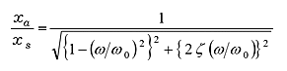
 img-dampingfactor3-02 (21) 


Equation for resonant frequencyimg-dampingfactor3-12Therefore, this is given in equation (21)img-dampingfactor3-13Substituting this into:

 img-dampingfactor3-03 (22)


From equations (21) and (22), the amplitude is the maximum amplitude.img-dampingfactor3-14To find the frequency at which this occurs:

 img-dampingfactor3-04 (28) 


To summarize:

 img-dampingfactor3-05 (29)


Solving this gives us:

 img-dampingfactor3-06 (30)

 img-dampingfactor3-07 (31)


If ζ ≪ 1, then ζ 2 ≈ 0, therefore;

 img-dampingfactor3-08 (32)

 img-dampingfactor3-09 (33)


img-dampingfactor3-15So then;

 img-dampingfactor3-10 (34)

 img-dampingfactor3-11 (35)


As shown above, the formula for calculating the damping ratio ζ from the full width at half maximum is an approximation formula when ζ ≪ 1, so it can only calculate accurately when ζ is 0.05 or less, and even if some error is allowed, it can only be calculated up to 0.1 or less.

[Reference] Damping ratio of structures and machinery

The damping ratios of actual structures and machinery are generally as follows:

Steel frame building 0.003 〜 0.04
Low- and mid-rise buildings (10 floors or less) 0.005 〜 0.12
Skyscrapers 0.02 〜 0.1
Steel tower 0.002 〜 0.03
Concrete tower 0.01 〜 0.02
Road bridge 0.02 〜 0.05
suspension bridge 0.002 〜 0.08
Suspension of large passenger cars 0.1 〜 0.3
Suspension of a small passenger car 0.2 〜 0.5
Motorcycle suspension 0.35 〜 0.45


[Reference materials]

1. "Controlling Vibration" by Kohei Suzuki (Ohmsha)

2. “Automotive Engineering Complete Book 11” (Sankaido)