Skip to content

Select your region & language

Global

Region

O-Solution Sound and Vibration Analysis System (Software)
O-Solution

There are many sounds in the world that are "annoying" even though they are not particularly loud. For example, the rattling and buzzing sounds that are sometimes heard from interior parts of a car while driving, or the buzzing noise that mixes with the rotation sound of a small motor. There are several reasons why these sounds are "annoying," but sounds that show significant temporal fluctuations are often perceived as irritating even if their volume (level) is not very high. Fluctuation sound analysis is an analysis that can extract only the components with large temporal fluctuations that are not affected by the level. This makes it possible to quantify various temporal fluctuation characteristics that were difficult to detect with conventional FFT, basic roughness, and fluctuation intensity. In addition, it is possible to evaluate various sound designs (flavoring) on two axes: timbre (pitch) and temporal fluctuation period, enabling deeper analysis than conventional techniques.

What is sound power level?

Acoustic power level is the total amount of acoustic energy radiated into the air by a sound source per unit time. While general sound pressure levels are affected by the distance from the noise source and the measurement environment, acoustic power level is uniquely determined in relation to the noise source. Therefore, acoustic power level is effective for setting noise specifications and evaluation standards for equipment, and for evaluating noise reduction effects, and is a global indicator used in environmental labels and noise regulations in various countries.

Methods for measuring acoustic power levels are defined by ISO standards and JIS standards. Measurement principles include the sound pressure method using a microphone and the SI method using an acoustic intensity probe.

  • What is sound power level?

Flowchart for measuring acoustic power level

The diagram below shows the procedure for measuring acoustic power levels using the sound pressure method in a semi-anechoic chamber. Prepare a test environment and microphone placement that conforms to the standard, and acquire the sound pressure level at each measurement point (ambient noise, target sound source, and reference sound source if environmental correction is required).
Afterward, the sound power level is calculated by adding the correction terms specified in the standard.

  • Flowchart for measuring acoustic power level

Features

Compliant with the latest ISO standards

It allows for easy measurement according to standards and output of reports in Excel format.
The standard settings can be customized, which is useful for calculations based on individual standards.

  • Compliant with the latest ISO standards

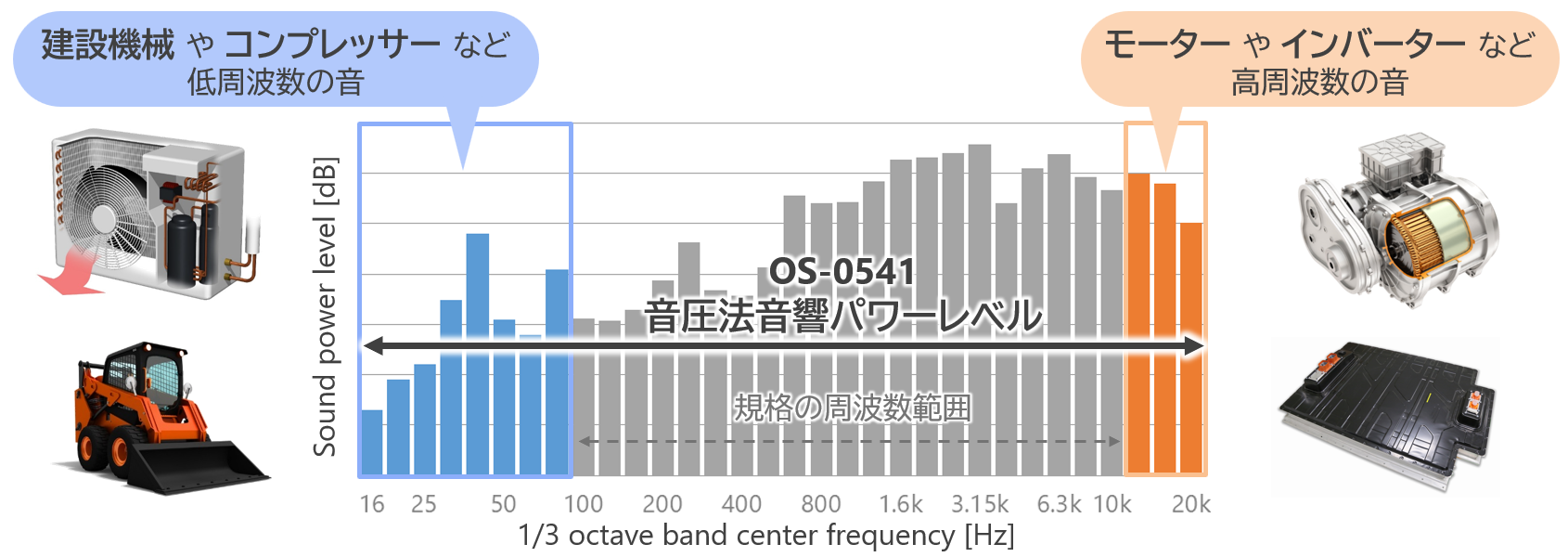
Calculates the acoustic power level up to 20 kHz in a 1/3 octave band.

Generally, sound power levels are calculated within the range of 100 Hz to 10 kHz as defined by standards, but it is possible to extend this frequency range to include both low and high frequencies for analysis.
If there are many measurement points, it is possible to perform measurements in multiple separate steps.*1

  • Calculates the acoustic power level up to 20 kHz in a 1/3 octave band.

Useful for root cause analysis

  • Simultaneous analysis and recording (synchronized recording with other sensors is also possible)

  • FFT, instantaneous sound power level calculation *2

  • Sound pressure level distribution display

After calculating the sound power level according to the standard, detailed analysis can be performed using the recorded data.
Post-analysis allows for the calculation of FFT and instantaneous acoustic power levels, efficiently identifying frequency peaks, timings, and sound source locations that contribute to increased acoustic power levels.
This allows for cause analysis without the need for remeasurement, leading to cost reductions in noise testing.

  • Useful for root cause analysis

*1 This service is available only if the sound source is reproducible and stable.
*2 While ambient noise correction and area correction are performed according to the standard, the calculations are performed using a different frequency or temporal resolution than the standard, so these are reference values and not compliant with the standard.
*3 To calculate the acoustic power level using the frequency resolution of the FFT, the OS-0522 FFT analysis function is required separately.

System Configurations

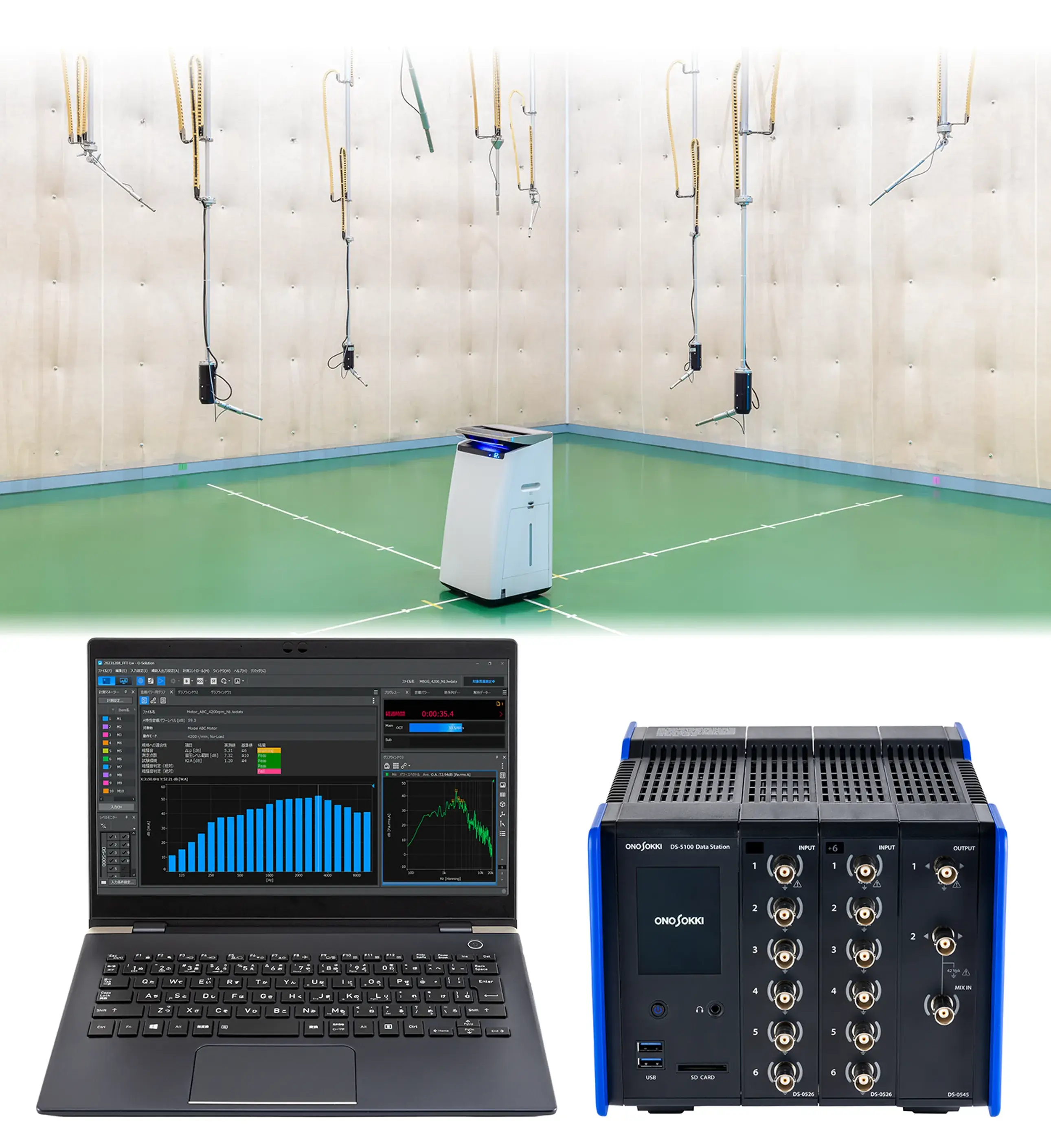
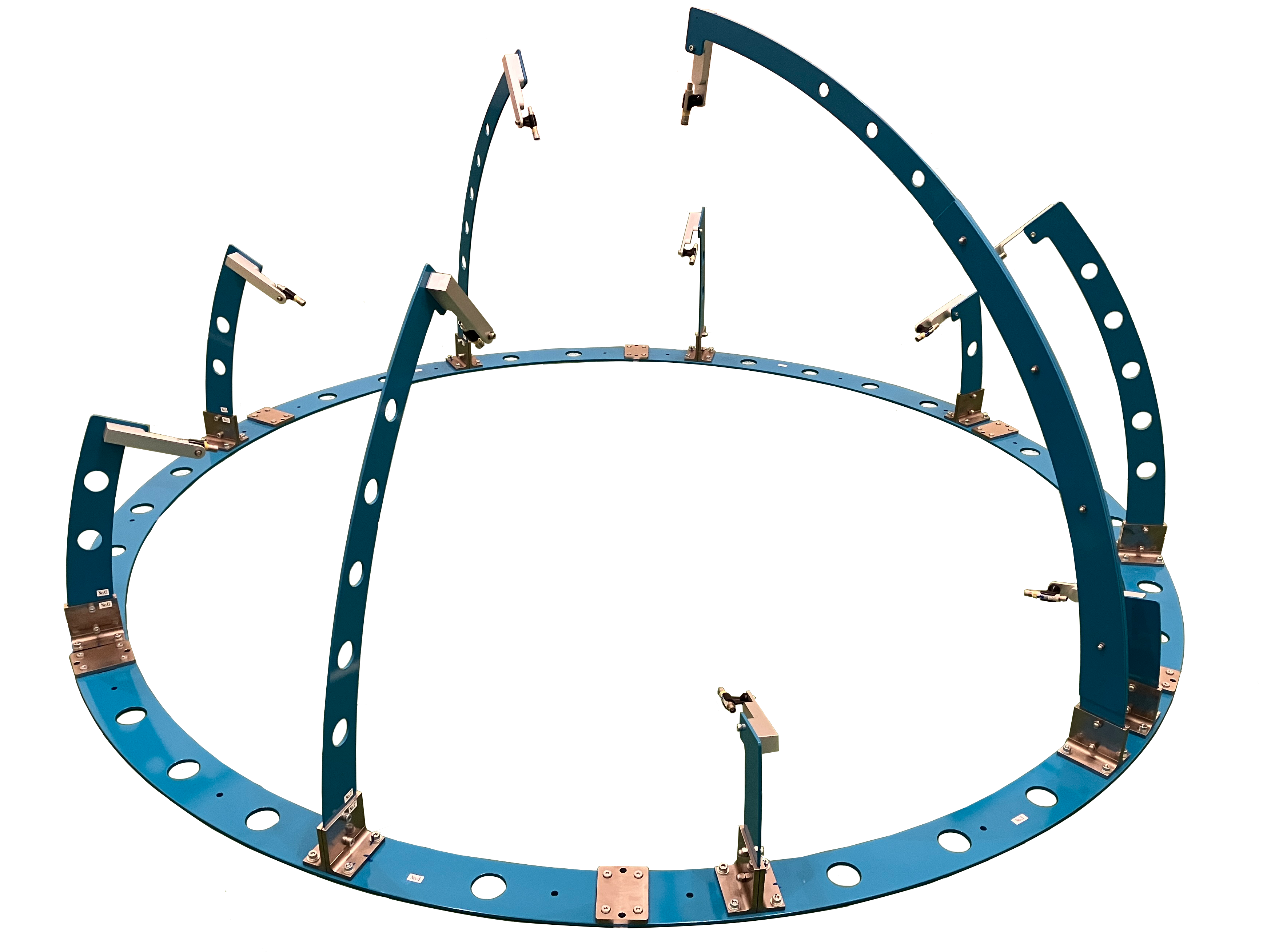
This is a typical configuration of a measurement system with 10 points arranged on a hemisphere.

Model name Product name quantity
DS-5100 Main Unit 1
DS-0526 6-channel 40 kHz input unit 2
OS-5100 Platform 1
OS-0524 Octave analysis function 1
OS-0541 Sound pressure method sound power level 1
OS-0542 Radiation sound measurement option (information technology equipment) 1
MI-1235 Microphone for measurement 10
MI-3111 Microphone preamplifier 10
MI-0311 Microphone extension rod 10
MX-2020 Microphone cable, 20 m 10
SC-2600 sound calibrator 1
- Pre-implementation support services -
- After-sales service -

* A separate computer is required. Recommended specifications follow those of O-Solution.
* A microphone stand or similar device is required to secure the microphone. Please contact us for details.
* A separate system operation verification fee will be charged if microphone stands or other equipment are selected or procured.

System implementation support service

To perform acoustic power level measurements in accordance with standards, it is necessary to confirm that the test environment and measurement methods are suitable for the customer's test specimen. Leveraging the technology cultivated through contract measurement and noise reduction consulting, we provide services that allow our customers to measure with confidence. Please contact us for details on our follow-up services.

Pre-implementation support services

Pre-implementation support services

Technical consultation regarding specific standards, etc.

Contract measurement of acoustic power levels
(System requirements survey, including the number of microphones needed)

Measurement of acoustic characteristics of existing test rooms
(Ambient noise, inverse square law, environmental correction value)

After-sales service

After-sales service

Lecture on sound power level standards

Software Delivery Instructions

Various seminars on noise measurement

Case Studies

Sound power level measurement for air conditioners, home appliances, machinery, office equipment, etc.

By measuring according to standards, you can more accurately understand the overall sound of the product.

  • Measurement scene

    Measurement scene
  • Measurement result image

    Measurement result image

Examples

  • Examples

Machinery such as air conditioning equipment, home appliances (washing machines, vacuum cleaners, etc.), multifunction printers, automotive parts (motors), and generators.

Reduced gearbox drive noise

By checking the sound power level and sound pressure level distribution simultaneously, it is possible to efficiently identify the source of the sound and verify the effectiveness of countermeasures.

  • Reduced gearbox drive noise

Acoustic power level of rotating machinery

Equipment with built-in motors tends to generate high-frequency noises that increase with rotational speed. Since high-frequency noises can sometimes be unpleasant, efforts to reduce them are important. The OS-0541 allows for post-analysis of measurement data to calculate the acoustic power level for tracking analysis. By understanding the overall acoustic power level in relation to rotational speed, it becomes possible to identify operating conditions that require countermeasures. The OS-0523 tracking analysis function is required separately.

  • Acoustic power level of rotating machinery

Specification

Supported standards

Sound pressure method acoustic power level: OS-0541

Compliant with standards applicable to various objects

The standard for acoustic power level measurement is defined to allow measurement in various environments without limiting the object being measured. The OS-0541 conforms to the standard for acoustic power level measurement using the sound pressure method with a microphone. The OS-0524 octave analysis function is required separately.

Test environment Standard Number of measurement points
Anechoic chamber, semi-anechoic chamber Precision method ISO 3745:2012, JIS Z 8732:2021 20 points~

Semi-anechoic chamber, outdoor

Practical application ISO 3744:2010 *, JIS Z 8733:2000 9, 10 points ~
Simple method ISO 3746:2010 4 points~
Reverberation chamber Precision method ISO 3741:2010, JIS Z 8734:2021 (comparative method only) 6 points~
High-frequency acoustic power level ISO 9295:2015 (Only applicable if discrete tones are not included) Citing ISO 3741 and 3744.

* Revisions to ISO 3744 are being considered. When the revisions are made, we plan to update the software to comply with the new standard.

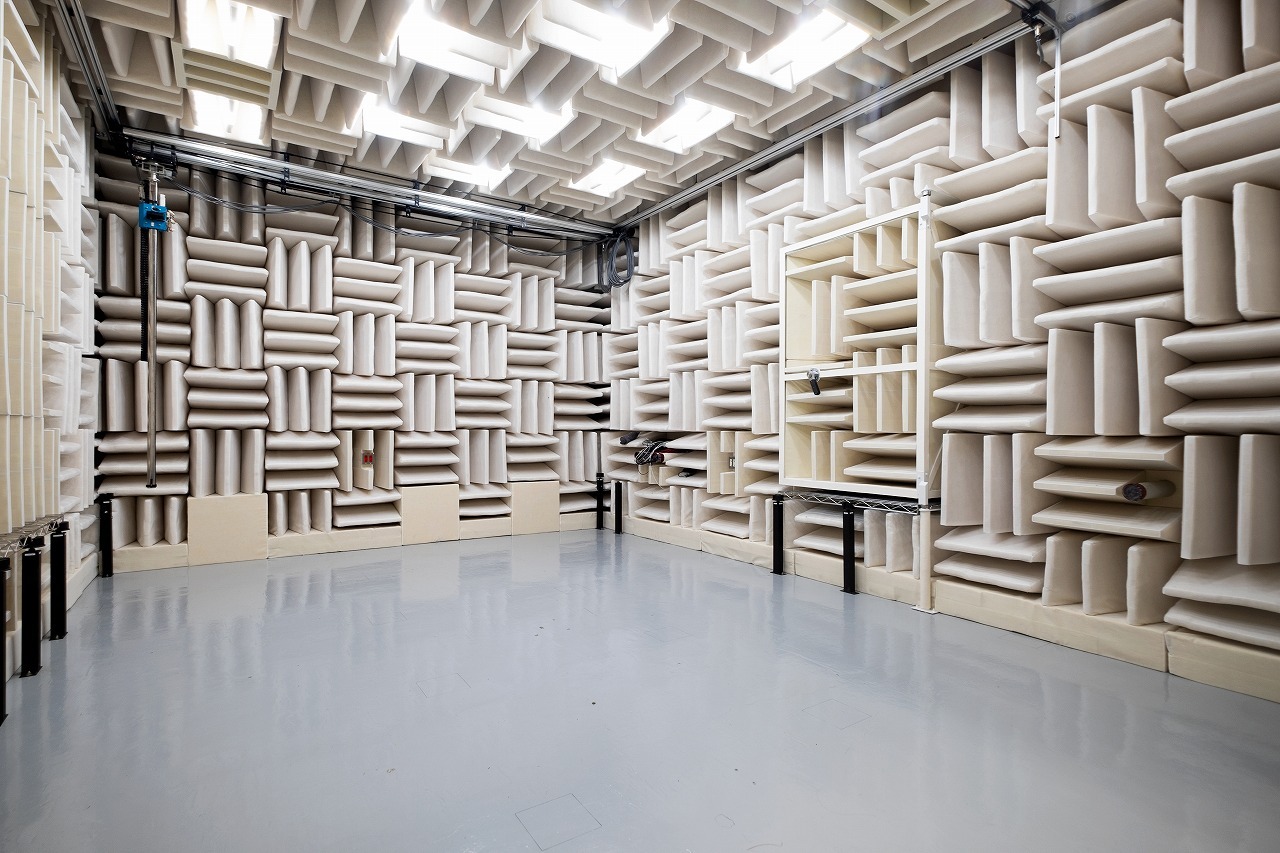
  • Measurement of acoustic power levels in a semi-anechoic chamber

    Measurement of acoustic power levels in a semi-anechoic chamber

    This is the most widely used measurement method. Measurements are taken using a hemispherical or rectangular prism arrangement of measurement points surrounding the object.

  • Measurement of acoustic power level in a reverberation chamber

    Measurement of acoustic power level in a reverberation chamber

    Compared to a semi-anechoic chamber, it allows for accurate measurements with fewer measurement points. There are direct and comparative methods, but the OS-0541 only supports the comparative method.

Radiated sound measurement option (information technology equipment): OS-0542

Measurement example (radiated sound pressure level at bystander position)
Radiated sound measurement option (information technology equipment): OS-0542

Measurement of radiated sound from computers, printers, multifunction devices, etc. is specified in the individual standard ISO 7779. This individual standard is cited when obtaining environmental labels. In addition to sound power levels, radiated sound pressure levels at the operator position or bystander position, and significant discrete sounds, if necessary, are calculated.

Supported standards
Measurement items Standard
Acoustic power level of information technology equipment ISO 7779:2018, JIS X 7779: 2012
Sound pressure level ISO 11201:2010
Radiated noise level ISO 9296:2017
Prominent discrete sounds ISO 7779: 2018, JIS X 7779: 2012
Tone-to-Noise Ratio, Prominence Ratio