

In this measurement column, we address frequently asked questions that we often receive at our customer service department and introduce the answers.
When measuring sound with a sound level meter or FFT analyzer, there is a setting called "frequency weighting characteristics (A/C/Z)". We receive many questions about this, such as "Which one should I set it to?", "What does A mean?", and "In what cases is C used?"
This time, we will introduce the frequency weighting characteristics A/C/Z used in sound measurement, delving into the background that established them.
Human hearing and loudness level
Sound is a fluctuation in air pressure (or similar). Even if the amount of pressure fluctuation is the same, if the frequency of the sound is different, people do not perceive it as the same loudness. Therefore, to evaluate the loudness perceived by humans, it is necessary to understand human hearing and correct for its characteristics.
Regarding steady sounds, the sound pressure level of a 1 kHz pure tone that a person with normal hearing perceives as being of the same loudness is defined as the 'loudness level'.
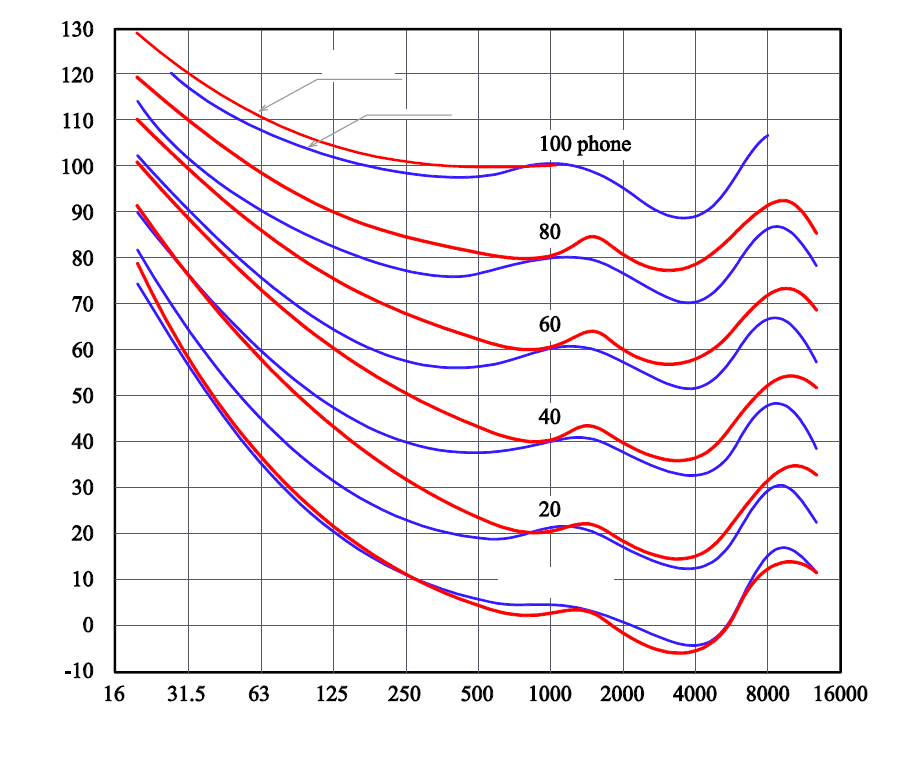
Measurements of changes in human hearing perception with frequency began with Fletcher and Munson and were repeated in 1957 by Robinson and others. Figure 1 shows, as the former standard (blue), the curves measured by Robinson and colleagues that relate the sound pressure level and frequency of pure tones perceived as equally loud by people with normal hearing. These curves are called equal-loudness contours or equal-sensitivity contours.
Subsequently, it was found that the equal-loudness contours measured by Robinson and others contained significant errors, and in 2003, a new equal-loudness contour was standardized as ISO 226. The new standard curve is shown in Figure 1 as the new standard (red line).
[dB]
図1 純音の等ラウドネス曲線(新旧比較)
What is frequency weighting characteristic A?
The A characteristic is a frequency weighting characteristic used to measure the loudness of noise (noise level) as specified in JIS C1509. It is used when measuring noise in factories or on roads, or when it is stipulated to measure noise levels and A-weighted sound pressure levels.
When simply explaining a characteristic, it may be expressed as 'frequency characteristics mimicking human hearing,' but this is merely an approximation and does not strictly reflect human auditory perception.
The A characteristic is a property created to approximate the equal-loudness curve for quiet sounds (old standard) as shown in Figure 1. There is also the C characteristic, which is created to approximate the equal-loudness curve for loud sounds, and in the past, these characteristics have been used differently based on the loudness of the sound being measured.
Subsequent research revealed that while this characteristic represents the loudness of auditory sounds, it is
not suitable for representing the loudness of noise, and it became clear that using the A-weighted characteristic curve is better for representing the loudness of noise even with loud sounds.
In 2003, a new equal-loudness contour was standardized as ISO 226, but the A-weighting characteristic, which was created to approximate the old equal-loudness contours, has not changed and continues to be used as a weighting characteristic for measuring noise loudness (noise level).
What is frequency weighting characteristic C?
The C characteristic is a property created to approximate the perceived loudness of loud sounds based on equal loudness curves (old standards). In the past, this characteristic was used to differentiate based on sound volume, but it has become clear that using the A characteristic curve is better for representing the loudness of noise, and currently, the C characteristic is rarely used. However, some European standards specify the use of the C characteristic in certain measurements.
Regarding the C characteristics, even now, acoustic calibration devices are sometimes used to calibrate sound level meters and microphones in order to avoid the influence of background noise.
In practice, unless the background noise is considerably large, calibrating using the Z characteristic will not have an impact. However, if the frequency of the calibration signal is not 1 kHz, the effects cannot be ignored, so the A characteristic is not used during calibration.
What is the frequency weighting characteristic Z?
The Z characteristic is a frequency weighting characteristic that has a flat response over a specified frequency range. It is used to measure sound (pressure fluctuations) as a physical phenomenon, independent of human hearing perception.
There are also general-purpose analysis devices that can be used for measurements of sound, vibration, voltage, and other parameters, which are equipped with frequency weighting characteristics A/C/Z for sound measurement. However, when analyzing anything other than sound with such analysis devices, the Z characteristic must always be used.
The Z characteristic was defined as a flat characteristic (FLAT) in the old standard for sound level meters, JIS C1502/1505. In the new standard, JIS C1509, the frequency range has been expanded to 10 Hz to 20 kHz and is defined as the Z weighting characteristic.
Other frequency weighting characteristics
As frequency weighting characteristics used in sound measurement, there are also the B characteristic, D characteristic, which are now hardly used,
and the G characteristic used for evaluating ultra-low frequency sounds, but details will be omitted.
Frequency weighting characteristics A/C/Z values
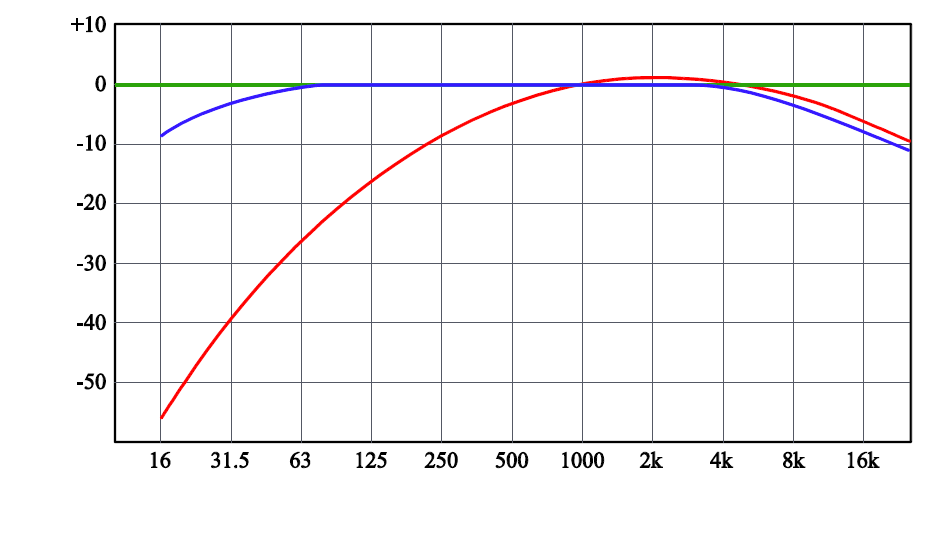
The values and graph of the frequency weighting characteristics A/C/Z specified in JIS C1509 are shown in Table 1 and Figure 2.
表1 周波数重み付け特性 A/C/Z (1/3 オクターブバンド)
|
No |
Nominal frequency (Hz) |
Exact Frequency (Hz) |
A characteristic (dB) |
C characteristic (dB) |
Z characteristics (dB) |
|
10 |
10 |
10.00 |
-70.4 |
-14.3 |
0.0 |
|
11 |
12.5 |
12.59 |
-63.4 |
-11.2 |
0.0 |
|
12 |
16 |
15.85 |
-56.7 |
-8.5 |
0.0 |
|
13 |
20 |
19.95 |
-50.5 |
-6.2 |
0.0 |
|
14 |
25 |
25.12 |
-44.7 |
-4.4 |
0.0 |
|
15 |
31.5 |
31.62 |
-39.4 |
-3.0 |
0.0 |
|
16 |
40 |
39.81 |
-34.6 |
-2.0 |
0.0 |
|
17 |
50 |
50.12 |
-30.2 |
-1.3 |
0.0 |
|
18 |
63 |
63.10 |
-26.2 |
-0.8 |
0.0 |
|
19 |
80 |
79.43 |
-22.5 |
-0.5 |
0.0 |
|
20 |
100 |
100.00 |
-19.1 |
-0.3 |
0.0 |
|
21 |
125 |
125.89 |
-16.1 |
-0.2 |
0.0 |
|
22 |
160 |
158.49 |
-13.4 |
-0.1 |
0.0 |
|
23 |
200 |
199.53 |
-10.9 |
0.0 |
0.0 |
|
24 |
250 |
251.19 |
-8.6 |
0.0 |
0.0 |
|
25 |
315 |
316.23 |
-6.6 |
0.0 |
0.0 |
|
26 |
400 |
398.11 |
-4.8 |
0.0 |
0.0 |
|
27 |
500 |
501.19 |
-3.2 |
0.0 |
0.0 |
|
28 |
630 |
630.96 |
-1.9 |
0.0 |
0.0 |
|
29 |
800 |
794.33 |
-0.8 |
0.0 |
0.0 |
|
30 |
1000 |
1000.00 |
0 |
0 |
0 |
|
31 |
1250 |
1258.93 |
0.6 |
0.0 |
0.0 |
|
32 |
1600 |
1584.89 |
1.0 |
-0.1 |
0.0 |
|
33 |
2000 |
1995.26 |
1.2 |
-0.2 |
0.0 |
|
34 |
2500 |
2511.89 |
1.3 |
-0.3 |
0.0 |
|
35 |
3150 |
3162.28 |
1.2 |
-0.5 |
0.0 |
|
36 |
4000 |
3981.07 |
1.0 |
-0.8 |
0.0 |
|
37 |
5000 |
5011.87 |
0.5 |
-1.3 |
0.0 |
|
38 |
6300 |
6309.57 |
-0.1 |
-2.0 |
0.0 |
|
39 |
8000 |
7943.28 |
-1.1 |
-3.0 |
0.0 |
|
40 |
10000 |
10000.00 |
-2.5 |
-4.4 |
0.0 |
|
41 |
12500 |
12589.25 |
-4.3 |
-6.2 |
0.0 |
|
42 |
16000 |
15848.93 |
-6.6 |
-8.5 |
0.0 |
|
43 |
20000 |
19952.62 |
-9.3 |
-11.2 |
0.0 |
[dB]
図2 周波数重み付け特性 A/C/Z
The nominal frequency is expressed as rounded values of the center frequencies of each 1/3 octave band. The exact frequency is the precise center frequency value of each band calculated using formula 1, with the band number n being an integer from 10 to 32.

Table 1 shows the values of frequency weighting characteristics for each 1/3 octave band. If you keep only the rows corresponding to the 1/1 octave band frequencies (16 Hz, 31.5 Hz, 63 Hz, 125 Hz, 250 Hz, 500 Hz, 1 kHz, ..., 16 kHz) and delete the other rows, you will have a table for the 1/1 octave band.
Formula for frequency weighting characteristics A/C/Z
The calculation formulas for frequency weighting characteristics A/C/Z are specified in JIS C1509 as equations (2) to (4). Here, f represents frequency [Hz].
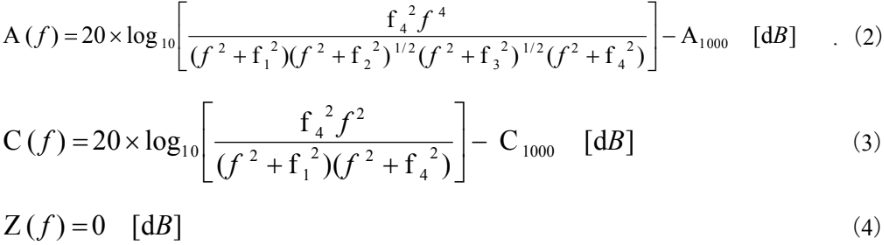
Here, each constant is as follows.
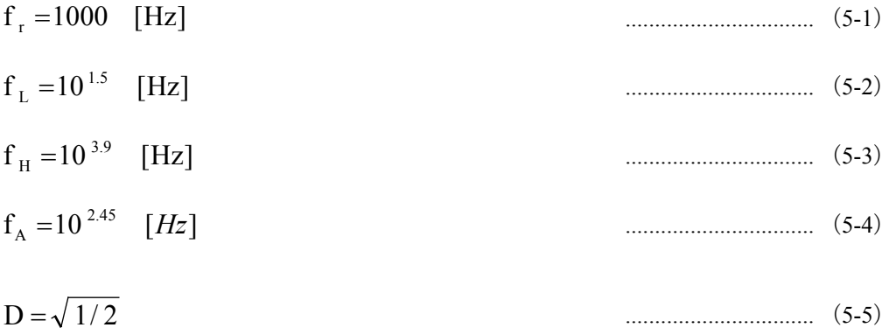


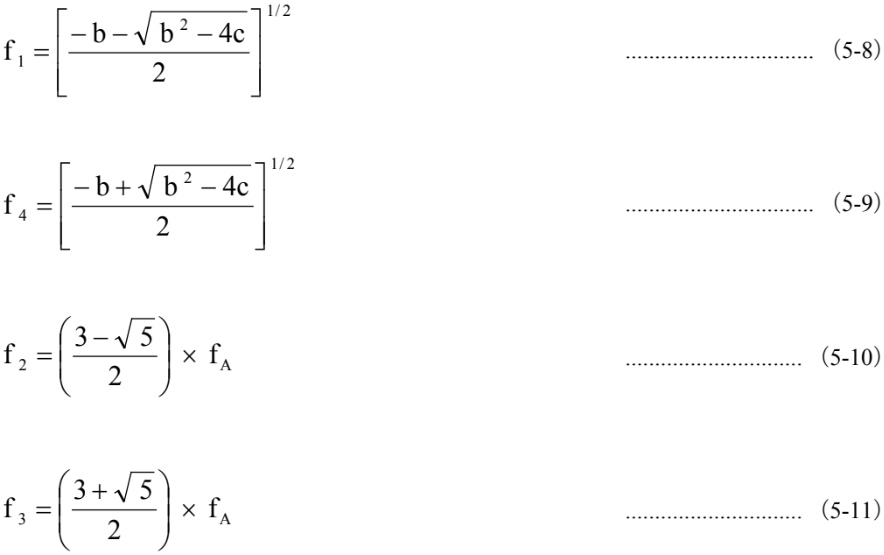
Also, A 1000 and C 1000 are normalization constants to ensure that the frequency weighting characteristics at 1 kHz are 0 dB.
Calculation example of frequency weighting characteristics A/C/Z
An example of frequency weighting characteristics A/C/Z has been prepared as an Excel file. You can download it from the URL below.
Calculation example of frequency weighting characteristics A/C/Z
(Excerpt from the email newsletter published on December 22, 2016)


