

Frequently Asked Questions about Laser Doppler Vibrometer
Question number FAQ-1351
Displacement measurement using the LV-0121A digital displacement gauge (fringe counter).
The digital displacement meter LV-0121A (fringe count) is an option for displacement measurement that utilizes an interferometer built into the sensor head, used in combination with a Laser Doppler Vibrometer. It counts the light and dark variations (interference fringes) caused by the phase shift between the reference light and the reflected light from the measurement target, and outputs the displacement in digital and analog signals.
Digital signals can be sampled at a maximum of 1 MHz with a maximum resolution of 0.155 nm (*), and it is possible to measure small displacements including a DC offset for analog displacement signals with a frequency range of DC to 100 kHz (-3dB). (Note: Displacement analysis software LV-0930 is required.)
The digital displacement meter LV-0121A can measure transient displacements (rectangular) and displacement amplitudes including DC offsets from a stationary state (DC). Displacements that include low-frequency amplitudes and offsets use the displacement output of the digital displacement meter, while high-frequency amplitudes utilize the velocity output of the Doppler vibrometer, enabling wideband amplitude measurement.
principle
The operating principle of the LV-0121A digital displacement meter utilizes the phenomenon where, when laser light is projected onto an object and the reflected laser light is superimposed with the original incident light, the intensity of the light is maximized when the phases (peaks and troughs of the waves) are aligned, and it becomes darker when they are completely opposite and cancel each other out.
In the figure below, when L 1 = L 2, the phases of the returning light from the reference mirror and the returning light from the measurement mirror are aligned, resulting in brightness. Next, when the measurement mirror moves and the optical path difference becomes λ/2 (λ = wavelength of the laser emission), they become out of phase (180 degrees shifted) and it becomes dark.
In this way, as the measuring mirror (the object being measured) moves, the optical path difference between L 1 and L 2 generates bright and dark interference fringes every λ/2. By counting these interference fringes, the amount of displacement can be measured.
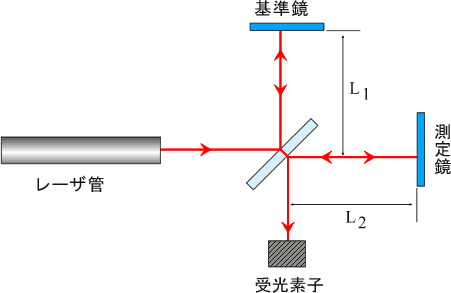
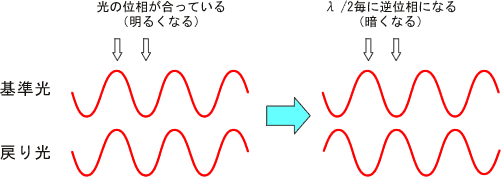
Note: The emission wavelength (λ) of the He-Ne laser used in the LV series is approximately 632.8 nm. The LV-0121A digital displacement meter measures displacement based on this wavelength.
measurement example
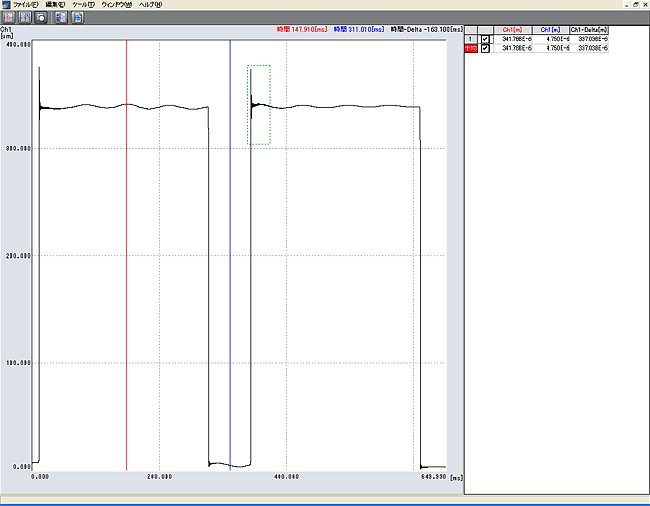
Rectangular displacement values of a cantilever using a digital displacement gauge LV-0121A
Last updated date: 2011-05-23