

Vibration Comparator Frequently Asked Questions
Question number FAQ-1393
How should I determine the comparison setting values?
How should I determine the settings when installing for the first time?
When setting the comparative value for the first time;
Depending on the measurement target, such as bearing damage, shaft misalignment, or imbalance, there are specific frequencies that should be noted.
- Core wobble, play, and imbalance in the axis can cause abnormal vibrations at frequencies that match the 'axis rotation speed'.
- In gears, abnormal vibrations occur at a frequency that matches the product of the axis rotational speed and the number of teeth.
- In the case of bearing damage, abnormal vibrations occur at high frequencies above a few kHz, so it is set to a 1kHz high-pass filter.
(The VC-3100 is also sold as a dedicated device for bearing damage assessment.)
Set the appropriate bandpass frequency according to each target frequency.
Measure the effective value or peak value for normal and abnormal cases, and estimate the judgment level. If data for abnormal cases cannot be obtained, it may be considered to set it slightly higher than the maximum value based on the normal value, or set it to +3σ (σ: standard deviation).
If an anomaly is detected, please review whether the comparative value is appropriate based on that data.
Also, if you have an FFT analyzer, determine which frequency bands are likely to experience anomalies from the measurement data and set the bandpass more precisely.
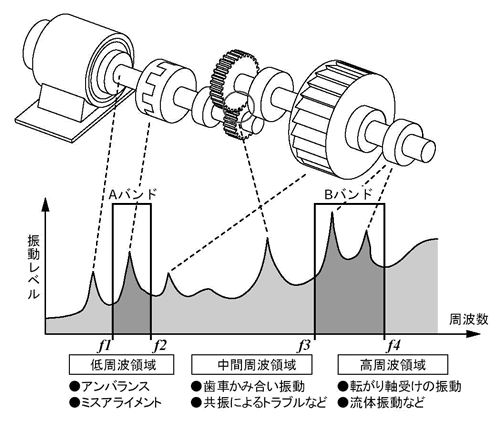
The VC-2100 allows for the independent setting of two types of bandpass (frequency band limitation) filters, outputting comparative judgment. The example in the figure below shows the settings for band A as f1 to f2 and band B as f3 to f4.
Last updated: July 15, 2002