

Acceleration Pickup Frequently Asked Questions
Question number FAQ-1379
Can measurements be taken at frequencies outside the NP-3110's specified range (5Hz to 15kHz)?
In the specifications section of the NP-3110 acceleration pickup catalog.
Resonant frequency 40 kHz
Frequency range from 5 kHz to 15 kHz
There is a description of this. Looking at the specification sheet that comes with the detector, the graph with the X-axis as frequency and the Y-axis as sensitivity shows a gentle mountain shape, being flat (within 3 dB) from 5 Hz to 15 kHz, with a peak around 40 kHz. Beyond 40 kHz, the attenuation increases significantly.
Measurements around 40 kHz will be unstable due to the resonance of the acceleration pickup itself, but this indicates that sensitivity improves from 15 kHz to 40 kHz (the output voltage becomes larger than the actual value). While it can be used to check for high-frequency vibrations without considering accuracy, it is preferable to use a model with a higher resonance frequency.
NP-3210 80kHz
NP-2910 60kHz
LV Series Laser Doppler Vibrometer
I recommend that you use it.
Please be careful
Installation
When installing an accelerometer pickup on the measurement target, there is a problem known as contact resonance. If the accelerometer pickup is mounted using a magnet base, double-sided tape, adhesive, or screws, and the output of the accelerometer pickup is observed relative to the measurement target, a frequency characteristic similar to that of the accelerometer pickup alone is selected. However, the resonance frequency can vary significantly depending on the method of installation. Generally, the order from lowest to highest resonance frequency is screw fixation, adhesive, magnet base, and double-sided tape (thick). With a magnet base, the resonance frequency is approximately 7kHz, which is considerably worse than the characteristics of the accelerometer pickup. Careful attention is required when installing the accelerometer pickup to measure high frequencies. The fundamental principle of installing the accelerometer pickup is that it should move as one with the measurement target. (Please refer to the instruction manual.)
weight
If the subject being measured is lightweight, the weight of the accelerometer can affect the measurements. It is necessary for the weight of the accelerometer to be less than 1/100 of the subject's weight, or at least less than a few tenths of it.
How to install the sensor
|
|
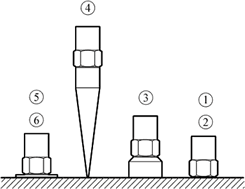
Characteristics of contact resonance frequency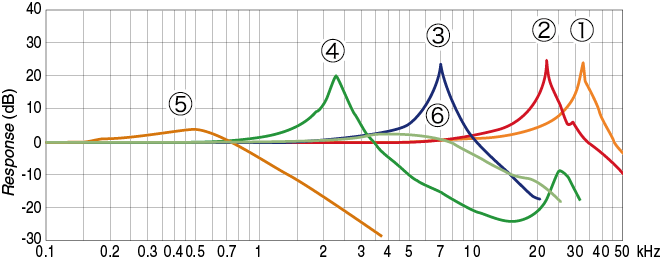
Last updated: 2002-08-19