

Acceleration Pickup Frequently Asked Questions
Question number FAQ-1367
How intense is 1G vibration in terms of sensation?
Human vibration perception varies significantly depending on the frequency of the vibration.
When displaying 1 G (9.8 m/s 2) with displacement X,
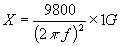 (mm)
At 100 Hz, it is 0.025 mm, while at 10 Hz, it changes significantly to 2.5 mm.
There is a vibration level meter that expresses ground vibrations and floor vibrations as felt by humans. It presents the magnification based on 10-5 m/s 2 in dB (logarithmic scale).
In 1 G

will become.
Additionally, the vibrations felt by humans range from about 1 Hz to 100 Hz, and the perception of their strength changes with frequency. This is referred to as vibration sensation characteristics, with the most sensitivity occurring around 4 to 8 Hz, and the perception dulls as the frequency deviates from this range. (Please refer to the VR-6100 catalog.)
Generally, the vibration values corrected for this vibration sensation characteristic are displayed as vibration levels in dB.
Additionally, there are seismic intensities ranging from 0 to VII. (Although magnitude is now used, the relationship between acceleration and intensity is shown in the table below.)
There is a relationship of 1G = 980 cm/s 2 = 980 gal (1 gal = 1 cm/s 2).
| seismic intensity | vibration level | seismic intensity | vibration level |
|---|---|---|---|
| No feeling | Below 55 dB (0.8 gal) | IV Moderate Earthquake | 85 ~ 95 dB(25 ~ 80gal) |
| Micro tremor | 55 ~ 65 dB(0.8 ~ 2.5 gal) | V Strong Earthquake | 95 ~ 105 dB(80 ~ 250 gal) |
| II Light Earthquake | 65 ~ 75 dB(2.5 ~ 8.0 gal) | 6. Violent Earthquake | 105 ~ 110 dB(250 ~ 400 gal) |
| III Weak Earthquake | 75 ~ 85 dB(8.0 ~ 25.0 gal) | VII Shock | above 110 dB (400 gallons) |
Since the purpose is to analyze the impact of floor vibrations from installed machinery, frequency is an important factor, and frequency analysis is being conducted.
as a unit of speed
1 kine = 1 cm/sec
There is.
Last updated: 2002-08-19