

Frequently Asked Questions about Laser Doppler Vibrometer
Question number FAQ-1358
Is it acceptable to install the sensors based on visual estimation? How does the tilt of the sensor affect the measurement values?
If the target is not a mirror surface, there are hardly any problems with estimating the installation by eye.
When the sensor (approximately the laser beam axis) tilts relative to the detection surface, it affects the following two aspects.
The reflection of the laser light decreases due to the tilt of the sensor, resulting in a lower resolution (SN ratio).
In the case of a mirror-like object, depending on the magnitude of the tilt, a situation may arise where the specular reflection component is completely absent, making detection difficult. In mirror detection (especially when the detection distance is long), it is necessary to adjust the tilt of the sensor while checking the position of the reflected light returning to the sensor.
※ In the case of non-mirror objects (scattering surfaces), the decrease in resolution with respect to tilt is slower than that of mirror surfaces, allowing for non-contact three-dimensional measurement through vector calculations.
The amplitude error can be calculated as a cosine error based on the angle formed between the tilted laser beam and the amplitude axis. If the tilt is 5 degrees, the error compared to the original amplitude value is about -0.4%, and at 10 degrees, it is about -1.5%. Generally, it is said that the human eye can distinguish a tilt of 1 minute (1/60 degree), so it is usually considered that there is no problem with installation by eye measurement. However, if you want to standardize the work, it is recommended to place a mirror on the irradiation surface and check the reflected light while installing.
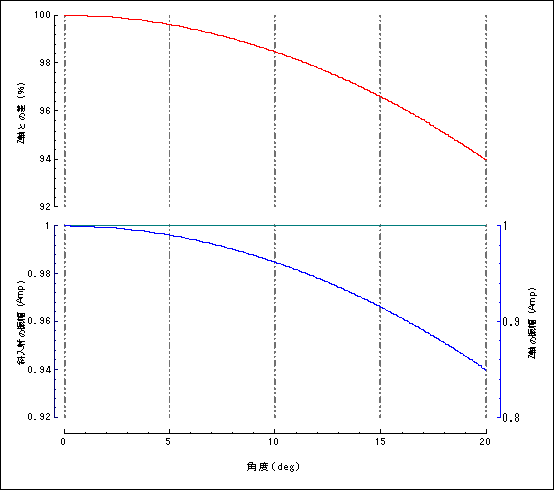
The influence of sensor tilt on measurement values.
Last updated date: 2011-05-23