

Frequently Asked Questions about Laser Doppler Vibrometer
Question number FAQ-1346
The influence of dark vibrations
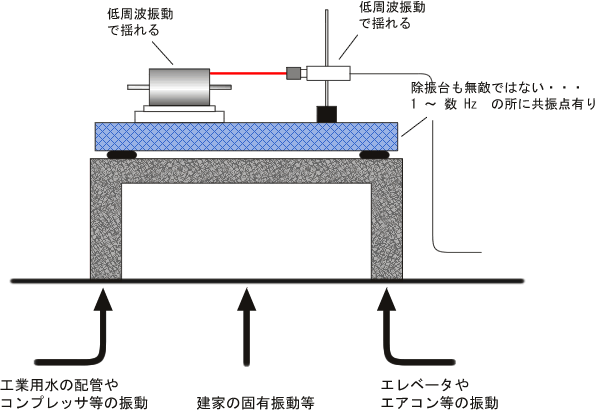
The measurement object and the Laser Doppler Vibrometer have a non-contact relationship. This means that the measurement object and the sensor are affected separately by background noise.
Although the frequency of this dark vibration is low, its displacement is surprisingly large. When measuring high-frequency vibrations or small displacements, the amplitude of the dark vibration can consume the dynamic range of the display or analyzer, making it impossible to achieve accuracy or resolution.
"Speed is effective when dark vibrations are large."
If the dark vibrations are large enough that even increasing the voltage range of the FFT analyzer or oscilloscope does not allow for the observation of the desired amplitude waveform, as it is buried in the waveform of the dark vibrations, it is recommended to observe using 'velocity' output rather than 'displacement' output. Measurements taken in 'velocity' can be converted to displacement through integration.
The advantage of measuring with 'speed' is that it is less affected by dark vibrations. This is because, although the displacement of dark vibrations is large, their frequency is low, meaning the speed is low. Measuring with 'speed' becomes more advantageous as the observed frequency increases.
For example, when measuring ultrasonic horns for ultrasonic welding;
| frequency | displacement output | speed output | |
|---|---|---|---|
| dark vibration | 5Hz (peak) | 500 micrometers (sheet amplitude) | approximately 16 mm/s |
| ultrasonic horn | 60kHz (sine wave) | 1 micrometer (single amplitude) | approximately 380 mm/s |
When comparing dark vibrations and ultrasonic horn vibrations, there is a difference of 500 times in displacement, and the displacement of the ultrasonic horn is output in a manner that is superimposed on the large dark vibrations. The range of the analyzer is set to match this dark vibration, making it impossible to accurately capture the small displacements of the horn in the analyzer.
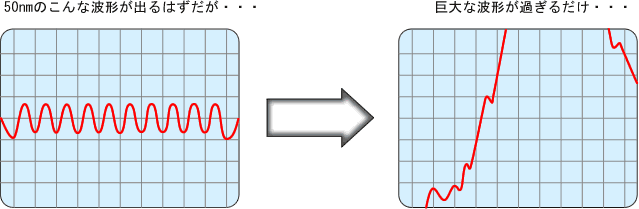
In contrast, with measurements based on speed output, the subject of measurement has a larger output, allowing the range of the analyzer to be adjusted to the subject. On one hand, measuring with speed and then performing integration with an FFT analyzer can yield more accurate displacement conversions. As in this example, for subjects with high vibration frequencies and small displacements, measurement using 'speed' is effective.
Last updated: 2004-04-19