

Torque Meter Frequently Asked Questions
Question number FAQ-1275
The torque, rotation, and voltage output response of the TS-410.
The output is through a first-order low-pass filter with a cutoff frequency of 10 Hz for both torque and rotation (see the next figure). At 10 Hz, the gain is -3 dB (1/ √2), and the gain is 1 (pass-through) below 2 to 3 Hz. Please note that it is not suitable for observing torque fluctuations and their timing (phase).
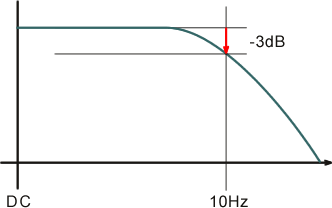
The following is an explanation of this concept.
- For voltage output signals with fluctuations of about 3 Hz or lower, output should be maintained at a gain of 1 (pass-through), while for frequencies above that and up to 10 Hz, the gain will gradually decrease.

- Components above 10 Hz are smoothed and output by a 10 Hz low-pass filter.

- In the case of changing in a lamp-like manner, it differs due to the lamp rise curve, but it follows with a slight delay.

- In the case of a stepwise change, it takes a time equivalent to the time constant τ to reach 63% of the step.

Note:
The time constant τ and the cutoff frequency f of a low-pass filter are related as follows.

Therefore, for 10 Hz, τ = approximately 16 ms.
In devices like the TS-3600, the response displays the time constant, but since the electrical processing differs from the TS-200/410, a comparison cannot be made. We kindly ask that the values obtained from the above formula be used as a reference.
Last updated date: 2008-09-30