

Torque Meter Frequently Asked Questions
Question number FAQ-1273
Bending radius of TS cable
When connecting signal cables to measuring instruments, there may be walls and limited wiring space. The cables will need to be bent smaller, but there is a question of "how much can they be bent?"
The cable is soft, so if you try to bend it forcibly, you can make small bends, but when bending the cable, it is necessary to ensure that the cable's insulation is not damaged and that performance is not compromised.
Generally, for braided shielded cables, the bending radius is said to be more than six times the outer diameter of the cable (diameter D).
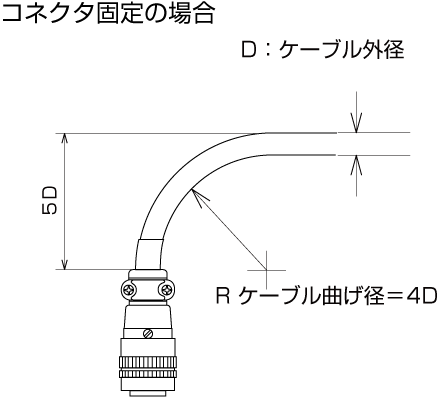
The signal cable has a connector, so if we consider that the cable is secured by the connector, it can be estimated that in this case, the guideline is more than 4 times. (In that case, the distance from the connector end is 5D.)
Outer diameter of TS cable D=φ8
| Bending radius (R) / Distance | |
| TS cable bending radius R - partial bending | 48 mm (6D) or more |
| TS Cable Bending Radius R - When Connector is Fixed | 32 mm (4D) or more |
| distance from the connector end | 40 mm (5D) or more |
Last updated: 2008-10-20