

Torque Meter Frequently Asked Questions
Question number FAQ-1266
Coupling selection and centering accuracy.
(1) Coupling and Alignment
Coupling alignment accuracy varies depending on the rotational speed and coupling type, but should be within 0.05 mm (T.I.R. = Total Indicator Reading, the difference between the maximum and minimum measured values).
Use a flexible coupling. If the coupling is not properly aligned with the connected equipment, a large bending load may be applied to the detector shaft, potentially damaging the bearings or breaking the shaft.
When the load caused by shaft misalignment is high due to the spring constant, strive for the most accurate alignment possible, even if the dimensions are within the allowable range. Also, if abnormal noise comes from the coupling, realign it to eliminate the noise. Take care to improve alignment accuracy as the rotational speed increases.
Keep the thrust load to approximately the mass of the coupling.
Also, please refer to this Torquemeter FAQ: “Coupling and Alignment Procedures”.
(2) Selection of Couplings
The mass of the coupling to be attached to the detector is determined by the maximum rotational speed used. Please refer to the curves corresponding to the detector ratings in the table below for selection.
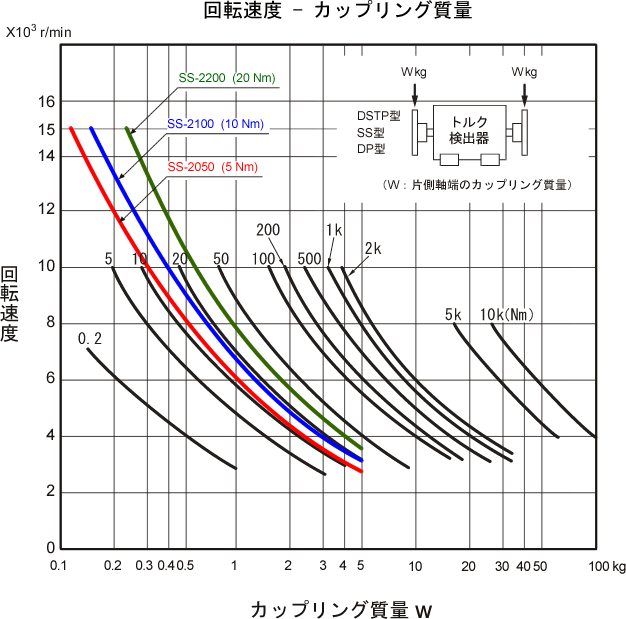
Various shape characteristics of couplings are released by coupling manufacturers. The figure below is an example targeted at speeds below 4000 r/min.
When used at rotational speeds above 4000 r/min, care must be taken regarding dynamic balance, eccentricity, and angular deviation. For relatively small capacity detectors, non-magnetic materials are recommended to avoid magnetic interference. For details, please contact the coupling manufacturing company.
Our company can also supply couplings as a set, so please make use of this.
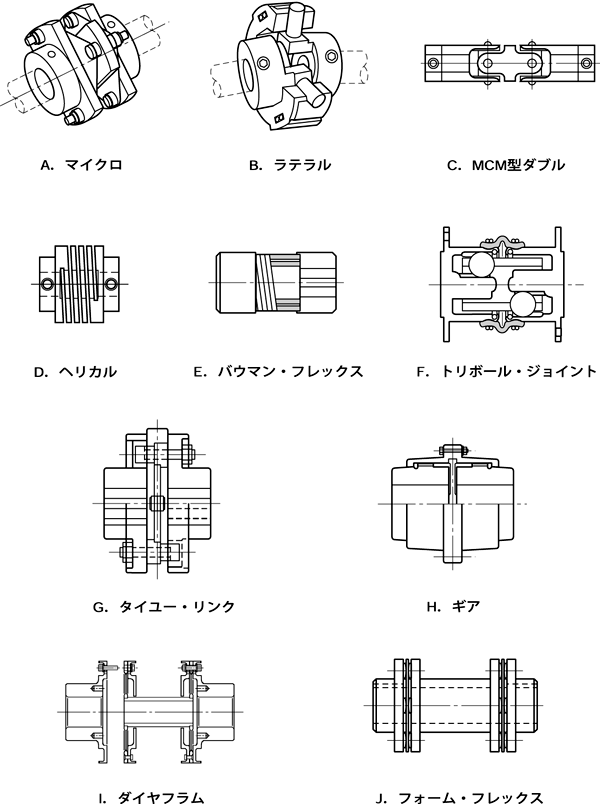
(3) Coupling "fit"
When coupling to the shaft end, please use "tight fit." If you use "loose fit," corrosion will occur at the shaft end, leading to changes in strength and mechanical dimensions, which can cause breakage. Normally, the "tightness" is 5D/10000 to 1D/1000 relative to the shaft end diameter D. Please apply a lubricant such as molybdenum disulfide to the "fit" surface.
Last updated: 2000-06-09