

Torque Meter Frequently Asked Questions
Question number FAQ-1263
Relationship between Factor and Zero in a Phase Difference Torque Detector (Temperature Characteristics)
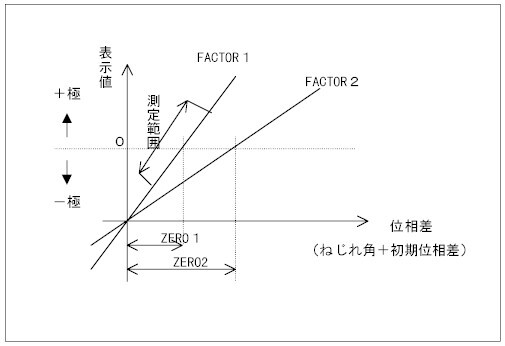
Phase difference torque detectors, such as the SS series, detect the twist angle of the torsion bar as a phase difference, and convert it to a torque value on the display unit for display. If the phase difference is plotted on the X axis and the torque display value on the Y axis, it looks like the diagram below.
(1) Factor
Factor is the ratio of the phase difference to the displayed value and corresponds to the slope of the line. Increasing the FACTOR increases the slope. In the diagram below, FACTOR1 > FACTOR2. Each torque sensor is individually calibration and inspected to determine its Factor. This determined Factor value is inscribed on the nameplate of the torque sensor.
(2) Zero
When unloaded, the initial phase difference is set to approximately 180 degrees. The "Zero" value is set so that the display shows 0 at this time. When torque is applied to the shaft and the torsion bar twists slightly, the phase difference increases by the amount corresponding to the twist angle θ.
(180deg + θ = +torque)
When the opposite torque (-torque) is applied, the phase difference decreases (180 degrees -θ). The direction of the applied torque determines the polarity of the display and voltage output.
(3) The relationship between FACTOR and ZERO
As you can see in the diagram below, a zero phase difference does not equal a zero display; therefore, when the FACTOR changes, the ZERO setting also changes. Since each torque sensor has a different Factor, you will need to set the "Factor" and "Zero" when using it for the first time.
(4) The effect of temperature
To achieve more accurate measurements, temperature effects can be compensated for. Significant temperature changes alter the spring constant of the torsion bar, subtly altering the phase difference with respect to the torque value.
The higher the temperature, the greater the torque displayed. The temperature coefficient is described in the torque sensor's instruction manual as follows:
Example: Temperature coefficient 0.03%/°C
The effect of temperature can be corrected using the formula (5) below. Note that there will be a change in the zero value due to factors affecting the entire torque sensor, so warm up the engine and wait until the torque sensor temperature stabilizes before adjusting the zero value and taking measurements.
(5) Method for compensating for temperature characteristics
The detector's nameplate clearly indicates the FACTOR, RANGE (or CAPACITY), and TEMP (torsion bar temperature) T1 from the in-house testing. The torsion bar temperature T2 during measurement is almost the same as the shaft end temperature, so please measure when the temperature is stable.
■To correct the measured value after measurement is complete, use the following formula:
(example)
T1 = 15°C, T2 = 45°C. Temperature coefficient 0.03%/°C. Measured value 25.00 N・m.
Actual value = (Measured value) ÷ {1 + (0.03 (T2 - T1) ÷ 100)}
= 24.78 N・m
Please refer to the torque sensor instruction manual for details.
Last updated: 2007-09-08