

sound level meter Frequently Asked Questions
Question number FAQ-1209
How to determine the sound level value from the DC output voltage?
1. Normal range DC output
The specifications are as follows.
- Full-scale output level 2.5 V ±10 mV
- Scale factor 0.5 V ±10 mV/10 dB
Therefore, when a steady sine wave is input, the DC output at the upper limit of the bar indicator will be 2.5V. The scale factor is 0.5V/10 dB. Thus, the output for a display level that is adB above the upper limit of the bar indicator is expressed by the following formula.
2.5+0.5×a/10 V
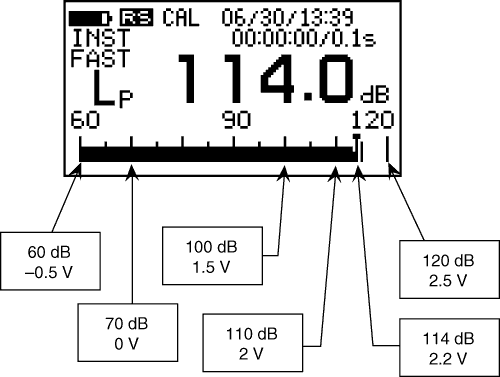
For example, if the measurement level is -20 dB below the upper limit of the bar indicator, the output will be as follows: it corresponds to 100 dB when the level range is 60 to 120 dB, and it also corresponds to 100 dB when the real-time level range is 40 to 120 dB.
2.5+0.5×(-20)/10 = 1.5 V
The electrical calibration signal is -6 dB from the upper limit of the bar indicator. Therefore, the DC output will be as follows.
2.5+0.5×(-6)/10 = 2.2 V
(When the level range is 60 to 120 dB, it corresponds to 114 dB.) Additionally, the indication value for a DC output level in microvolts (aV) is from the upper limit of the bar indicator.
(a-2.5)/0.5×10 dB
It will be separated only. For example, the indicated value when the DC output is 1.65 V is from the full scale.
(1.65-2.5)/0.5×10 = -17 dB
It is only separated, and when the level range is 60 to 120 dB, it corresponds to 103 dB, and in real-time at 40 to 120 dB, it also corresponds to 103 dB. The maximum output level for DC output is 3 V, which is the same as the level of a sine wave showing a value 10 dB higher than full scale. When a steady sine wave exceeds this value, an overmark is displayed.
2. Wide range DC output
The specifications are as follows.
- Full-scale output level 2.5 V ±5 mV
- Scale factor 0.25 V ±5 mV/10 dB
Therefore, when a steady sine wave is input, the DC output at the upper limit of the bar indicator will be 2.5V. The scale factor is 0.25 V/10 dB. Thus, the output for a display level that is adB above the upper limit of the bar indicator is expressed by the following formula.
2.5+0.25×a/10 V
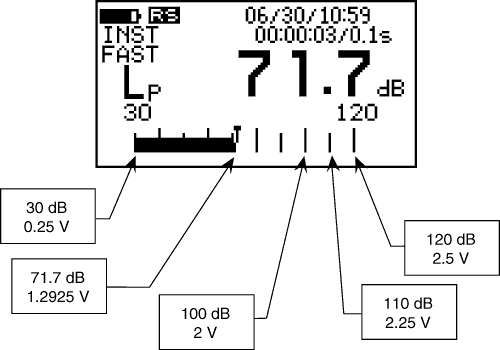
For example, if the measurement level is -20 dB below the upper limit of the bar indicator, the output will be as follows. (In the case of a level range of 30 to 120 dB, this corresponds to 100 dB.)
2.5+0.25×(-20)/10 = 2 V
The electrical calibration signal is -16 dB from the upper limit of the bar indicator. Therefore, the DC output will be as follows.
2.5+0.25×(-16)/10 = 2.1 V
(When the level range is between 30 and 120 dB, it corresponds to 104 dB.) Additionally, the indicated value for the DC output level in aV is from the upper limit of the bar indicator.
(a-2.5)/0.25×10 dB
It will be only a certain distance away. For example, when the DC output is 1.2925 V, the indicated value is from full scale.
(1.2925-2.5)/0.25×10 = -48.3 dB
It is only separated, and in the level range of 30 to 120 dB, it corresponds to 71.7 dB. The maximum output level of the DC output is +2.75 V, which is the same as the level of a sine wave that indicates a value 10 dB higher than full scale. When a steady sine wave exceeds this value, an overmark is displayed.
Last updated: 2001-10-12