

sound level meter Frequently Asked Questions
Question number FAQ-1193
Calibration (sound calibrator, contract calibration, certificate)
To obtain more accurate measurements with less error, it is recommended to regularly calibrate the microphone of the sound level meter. There are two methods for the calibration of the sound level meter: using the built-in oscillator of the sound level meter and using a separate acoustic calibrator (SC-3100).
1. calibration procedure using built-in transmitters
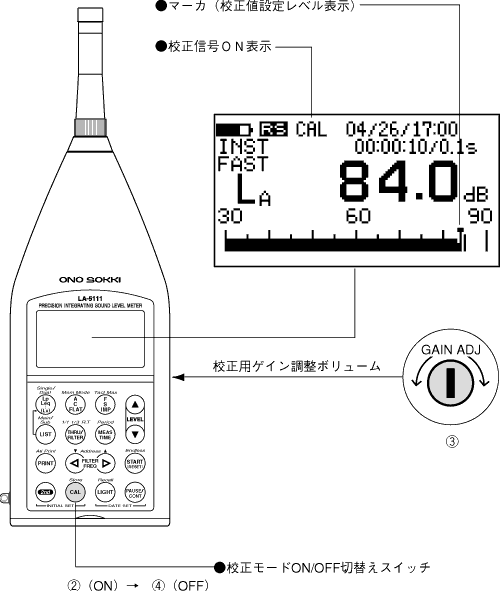
Calibration using an internal transmitter refers to a method of electrically calibrating the sound level meter by utilizing the constancy of the microphone's sensitivity. When the level range is set between 30 to 90 dB and the internal calibration signal is turned ON, a calibration signal (frequency 1 kHz) is output from the output terminal. This calibration signal corresponds to a value of -6 dB relative to the full scale of each level range (for wide range, it is -16 dB). Additionally, the calibration signal output from the output terminal can also be used as a level calibration signal for each device connected to the sound level meter.
◆ Operation
- Set the measurement conditions of the sound level meter for calibration.
Measurement mode: INST (panel switch [Tact Max])
Measurement range: reference range (30–90dB) (level range switch [△・▽]) - Turn ON the calibration signal.
Press the panel switch [CAL] to turn ON the calibration signal, and the marker will move to the calibration value setting position. - Adjust the displayed value to 84.0 dB.
Using the marker position on the bar indicator as a guide, turn the gain adjustment knob for the “calibration” using the included adjustment screwdriver until the displayed value reaches 84.0 dB. Please note that you should not turn or press the gain adjustment knob for the “calibration” with excessive force. Doing so may cause a malfunction. - Turn off the calibration signal.
After calibration is complete, pressing the panel switch [CAL] again will turn off the calibration signal.
2. calibration procedure using acoustic calibration
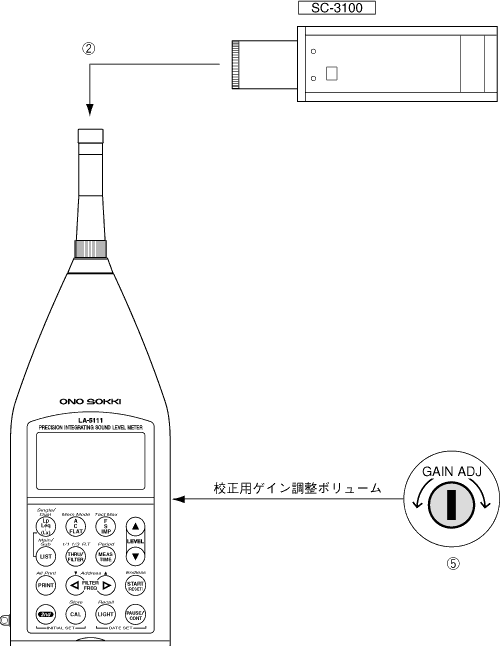
This is a method for acoustically calibrating using an acoustic calibrator. If you wish to perform calibration with the acoustic calibrator, please purchase the separately sold acoustic calibrator (Sound Calibrator SC-3100).
◆ Operation
- Set the measurement conditions for the sound level meter as follows for calibration.
display screen Standard screen (panel switch [LIST]) Display LP indicates (panel switch [LP / Leq ...]) frequency correction FLAT display indicates P (panel switch [A / C / FLAT]) Measurement Mode INST (Panel Switch [Tact Max]) SC-3100 Calibration frequency 250Hz (representative value) sound pressure level 124dB (representative value) - Set the microphone of the sound level meter to the acoustic calibration device.
Insert the microphone into the sound calibrator's inlet. - Turn on the power of the audio calibration device.
- Set the measurement range to the maximum position so that the calibration level does not exceed the full scale.
- Set the calibration value to the calibration reference sound pressure level.
Use the included adjustment screwdriver to turn the calibration gain adjustment volume so that the calibration value matches the same value as the calibration reference sound pressure level of the acoustic calibrator. Please do not turn or push the calibration gain adjustment volume with excessive force at this time. It may cause damage.
<Note>
The calibration reference sound pressure level has a specific value determined by the acoustic calibrator. Before performing the calibration, please check the calibration reference sound pressure level of your acoustic calibrator by referring to the inspection report included with the acoustic calibrator.
3. Entrusted calibration
We offer calibration services (for a fee) upon collection of the main unit. A test report, and upon request, a traceability system diagram (for a fee) and a calibration certificate (for a fee) will be attached.
4. Certificate of Inspection
After the main unit is retrieved and inspected, we undertake the task of having it tested at a public institution. The 'certificate of calibration' is issued in accordance with the Measurement Law and a seal with a validity period of 5 years is affixed. For more information regarding the certificate, please refer to the 'What’s New Ono Sokki Report' section titled 'What is a sound level meter?'.
Last updated: 2001-10-12