

Frequently Asked Questions about the Tachometer
Question number FAQ-0932
The relationship between the display of TM-3100 and its analog/BCD output.
The signal processing flow of the TM-3100 display and analog/BCD output is as follows.
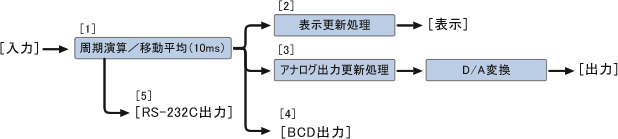
Periodic calculations/moving averages
The input signal is repeatedly processed every 10 ms to determine speed. If 'moving average is OFF', the current periodic calculation is used as data. If 'moving average is set to 32', a moving average is calculated from the last 32 periodic calculation values, and this average value is used as data. If the input signal frequency is high and there are multiple signals within 10 ms, the calculation is based on the average period of these multiple signals. Conversely, for low frequencies such as 10 Hz (period 100 ms), the periodic calculation value changes as it waits for signal reception. Therefore, until then, about 10 data points will be the same.
Display update process
The data for the update time is used to perform a cumulative average and display the speed. In the case of a 1-second setting, approximately 100 data points (1s ÷ 10ms = 100) will be displayed as the cumulative average value. However, the maximum number of data points for this cumulative average is set to 120, so if the update time is set to 2 seconds or more, the cumulative average value will be displayed based on the 120 data points (approximately 1.2 seconds) immediately after the update. Therefore, whether the setting is 2 seconds or 10 seconds, the average number of data points remains 120, but the difference lies in whether the cumulative average and display updates occur at 2-second intervals or 10-second intervals.
Display update analog output update process
The data of [1] just before the timing of the analog output update is converted to D/A and output. In the case of a 1-second setting for the analog output update, D/A conversion occurs at 1-second intervals. Generally, the analog output update time is set to 10 ms, and a moving average setting is used to adjust responsiveness.
■Example Setting 1: "Display Update 1 s, Moving Average OFF, Analog Update Time 1 s"
| Display | The periodic operation values are collected every 10 ms, and the average of approximately 100 data points over a 1-second period is calculated and displayed. |
|---|---|
| Analog Output | Every 1 second, the calculation value from the previous 10 ms cycle is read and converted to a D/A signal. Therefore, the instantaneous speed at that timing is output with a sample interval of 1 second. |
■Example 2: In the case of "Display update 1 s, moving average 32, analog update time 1 s"
| Display | Use the moving average value every 10 ms as data, perform an average over 1 second (approximately 100 data points), and display that value. |
|---|---|
| Analog Output | The moving average value calculated every 10 ms is used as data, and the most recent data is read and converted to D/A output at 1-second intervals. Therefore, the speed of the moving average is output at a sample interval of 1 second. |
[4] BCD out
BCD output is similar in concept to analog output. It outputs instantaneous data of 10 ms or a moving average value at the timing of an update time of 100 ms.
Note: If the input signal is 1 second, the same value will be output in BCD approximately 10 times (for about 1 second). In request mode, it outputs the data at the moment the request is received.
[5] RS232C
The RS232C will reply with instantaneous data when it receives the 'RMD' command.
Remarks Interval Measurement, Link Memory, and RS232C When reading the latest data via RS232C in the "middle" of interval measurement with link memory, block 2 is read. (RPE0,2: Command to read the average value of interval 2) Due to internal processing, block 2 always contains the latest data. When interval measurement is stopped, the blocks are rearranged so that block 1 has the latest data, block 2 has data from one interval prior, and block 3 has data from two intervals prior. |
Last updated: 2012-05-21