

Frequently Asked Questions Related to Electromagnetic Detector
Question number FAQ-0864
MP-900 series detection gears and output waveforms
The relationship between the detection gears and output waveforms of the MP-900 series (excluding MP-981 and AP-981)
The relationship between the detection gears and output waveforms of the MP-900 series (excluding MP-981 and AP-981)
■ Features of the MP-900 Series
(1) Non-contact detection, capable of detecting up to high speeds
(2) Excellent rigidity and environmental resistance, high durability
(3) No power supply required (except for MP-981, AP-981)
(4) Selectable P/R
(The number of teeth on the detection gear directly corresponds to the signal per rotation.)
(5) The installation position can be anywhere as long as a gear can be attached to the measurement target.
About the Detection Gear
Due to the principle of the detector, ferromagnetic materials (such as S45C, SS400, etc.) are used.
When measuring the normal rotation speed, if the gate time of the counter (measurement time) is set to 1 second, the rotation speed can be directly read on the counter by using a gear with 60 P/R.
Number of signals per second (frequency) = Rotational speed in r/min × 60 P/R
Shape of the detected gear.
The figure below shows the output waveforms of the detector in various shaped detection gears.
For spur gears, the involute tooth profile is the most suitable, while square, triangular tooth profiles, or round teeth will result in waveforms with high-frequency distortion. Care must be taken as distortions in the output waveform can occur if the teeth are partially chipped.
Additionally, in cases where the gear is magnetized, interference with the permanent magnet inside the detector can cause the output voltage to decrease or result in abnormal waveform signals, so please exercise caution.
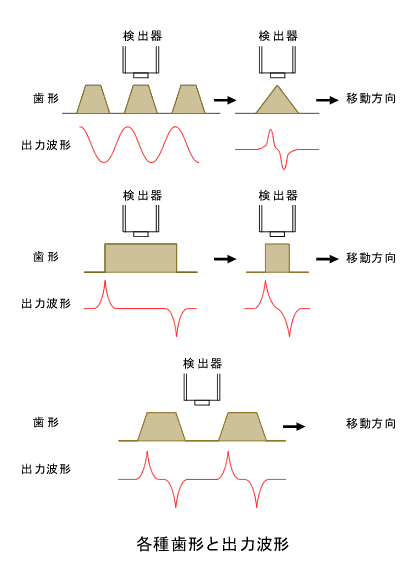
Recommended gear tooth profile.
The figure below recommends using involute gears to obtain the optimal output voltage.
Commercially available gears can be used.
Example of a commercial manufacturer: Kyouiku Gear Industry Co., Ltd.
If produced, please refer to "recommended gear".
■ MP-001 Type Detection Gear
We offer the MP-001 Type Detection Gear as an option.
| module | 1 |
|---|---|
| number of teeth | 60 |
| tooth shape | involute |
■MP-900 Series Output Voltage Waveform
When combined with an involute gear as mentioned above, it outputs an approximate sine wave according to the number of teeth.
The amplitude of that approximate sine wave is
(1) Detection gear and MP-900 series mounting gap
(2) Number of modules of the detection gear
(3) Magnetic properties of the detection gear
(4) Magnetic effects around the detection gear and MP-900 series mounting
(5) Rotational speed (frequency)
(6) Length of signal cable
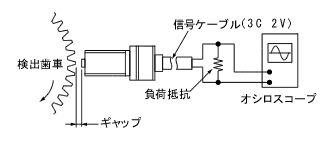
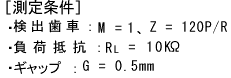
It varies under such conditions. The rotation speed (converted to signal output frequency) is taken on the X-axis, and amplitude on the Y-axis, with the table below showing representative amplitude characteristics.
| measurement conditions | |
 |
 |
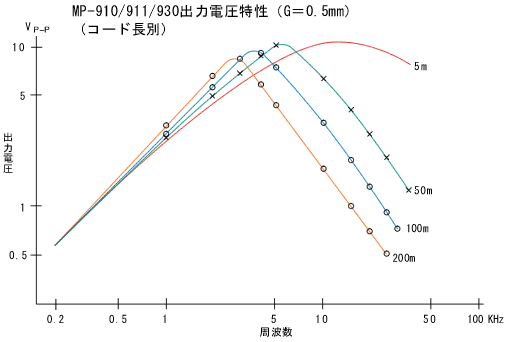
List of relationships between gears and the MP-900 series.
| G: Gap between the detection gear. | The narrower the spacing, the larger the amplitude at low rotation speeds. |
|---|---|
| tooth profile of the detection gear | involute |
| material of the detection gear | Ferromagnetic materials (those with a strong property of being attracted to magnets) such as S45C and SS400. |
| Size of the detection gear | The unit called module (M) is used. This value determines the size of the teeth, and teeth with the same module can mesh together. Module = (Pitch Circle Diameter) ÷ (Number of Teeth) M = 1 or more, tooth width 5 mm or more |
| Installation Caution | - Do not install multiple MP-900 series units in close proximity. - Ensure that it is not in a strong magnetic environment with variations such as large motors. |
| Length of the signal code | Dedicated signal code or 3C2V coaxial cable If the signal code exceeds 20 meters, please use the PA-150 model dedicated amplifier. |
Last updated: 2006-09-29