

Magneto-Electric Rotation Detector Frequently Asked Questions
Question number FAQ-0851
Why does the duty cycle change in the MP-981 Magneto-Electric Rotation Detector?
Change in duty ratio (dependent on rotational speed)
When a magnetic material moves through a magnetic field, eddy currents are generated on its surface, and these eddy currents produce a magnetic field (indicated by the green arrow). This magnetic field interferes with the magnetic field generated by the magnetic resistance sensor, resulting in a change in midpoint voltage.
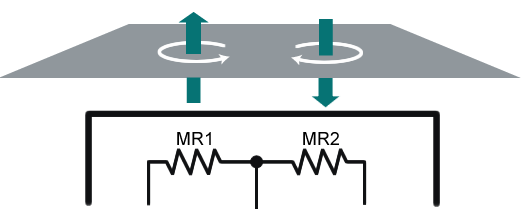
The direction of the eddy currents changes depending on the direction of the moving magnetic material.
Additionally, since the eddy currents increase in proportion to the speed, as the rotational speed increases, the change in midpoint voltage also becomes larger.
Change of duty ratio (temperature dependent)
Magnetoresistive elements have temperature dependence. The MP-981 uses two magnetoresistive elements, so slight differences in temperature characteristics between the elements cause changes in the midpoint voltage. The figure below is an example of this.
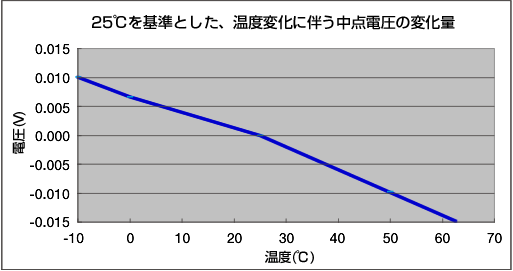
Change in the midpoint voltage of the output.
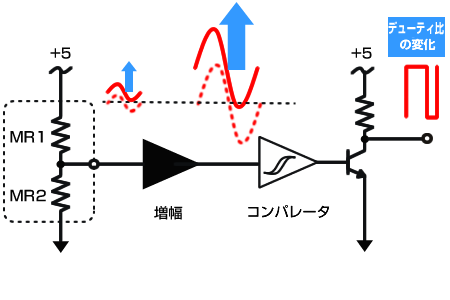
The signal amplitude obtained from the magnetic resistance sensor is small, around tens of mV, so after amplification, the waveform is shaped to produce the final signal. Since the change in midpoint voltage is also amplified, if the midpoint voltage changes due to temperature variations or increases in rotation speed, it may result in changes in the duty cycle of the final output signal or even the disappearance of pulse output.
Last updated: 2013-06-17