

Basic FAQ for FFT Analyzer
Question number FAQ-0777
What is phase?
Phase refers to the positional information of a periodically varying wave, for example, the input signal.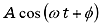 In a cosine wave (or sine wave) like (ω t + φ), it refers to the angle (phase angle). Here, the phase φ at t = 0 is specifically called the initial phase, and this φ is usually referred to as the phase.
The phase representation is based on the cosine waveform (For φ = 0, if φ is positive, it leads to a phase advance, and if negative, it results in a phase delay. The representation of this phase component as a function of frequency is called the phase spectrum, which refers to the phase angle in a 1 ch analysis based on the data acquisition point. Since the unit of the phase angle is in radians (rad), the vertical axis of the phase spectrum is -π < φ ≦ π, but in FFT analyzers, it is usually expressed in degrees for clarity, that is -180 deg < φ ≦180 deg.
 |
Last updated: November 16, 2009