

DS-2000 Frequently Asked Questions
Question number FAQ-0694
Example of Use 1: Vibration Analysis of Structures
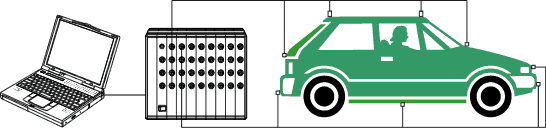
One of the biggest causes of vibration and noise in robots, machine tools, aircraft, and vehicles is the resonance phenomenon. Among the analysis methods, a popular approach is measuring the frequency response function of the object using an impulse hammer. Vibration using an impulse hammer does not require the structure to be attached to a shaker, and the measurement time is short, making it suitable for on-site measurements, including troubleshooting. Gradu can expand the number of channels from a minimum of 2 channels to a maximum of 32 channels. For single point excitation and response, a minimum of 2 channels is required, while measuring X, Y, and Z simultaneously requires 4 channels. In the case of large structures, a maximum of 31 response signals can be obtained with 1 channel of excitation.
■Measurement Example
1) The structure is excited by an impulse hammer.
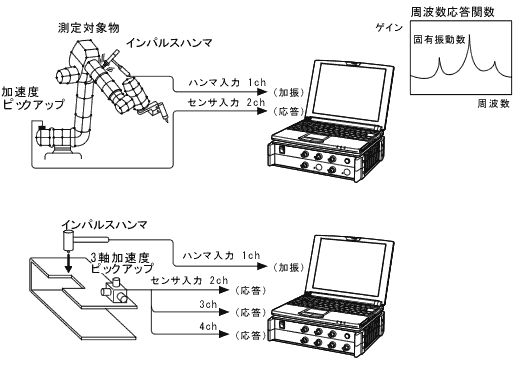
- The impulse hammer can directly input the acceleration pickup.
- You can expand the number of channels from 2 to 32.
- By setting up the optional signal output, vibration experiments can be conducted using the shaker.
- By setting the 2ch signal output, simultaneous vibration at two points can be achieved.
- It is possible to perform modal analysis directly on the measurement results.
- By using multi-point simultaneous measurement, it is possible to display the actual vibrations in an animated format.
2) Example of multi-point simultaneous vibration measurement using a multi-channel input unit.
■ Application: Measurement of frequency response functions for various structures.
Automobiles (body, engine cylinder block, etc.), automotive parts (oil pan, wiper, power steering, etc.), office automation equipment (printer, copier, hard disk, etc.), machine tools, rotating machinery (pump, fan, turbine blades, etc.), robots, ships, home appliances (chassis for DAT, CD, VTR, washing machines, refrigerator compressors, air conditioners, fans, etc.)
Last updated: 2000-10-13