

DS-2000 Frequently Asked Questions
Question number FAQ-0194
Why do the peaks of the time axis waveform not match the peaks of the spectrum?
Even when the same signal is displayed on an FFT analyzer, the peaks of the waveforms do not match because what is displayed in the time domain (time axis waveform) and the frequency domain (power spectrum) is different. I will explain this meaning next.
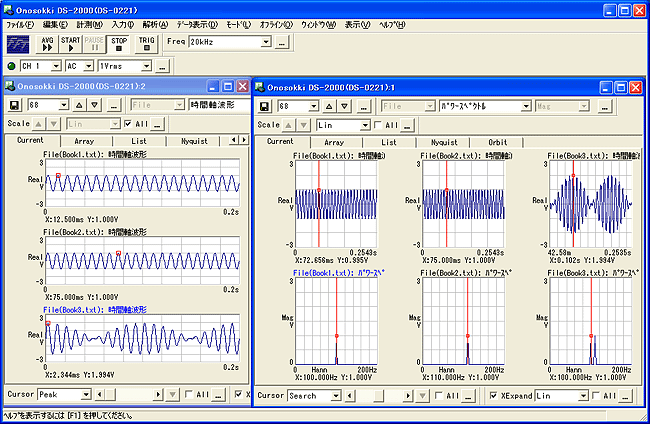
The left side of the diagram shows, from top to bottom, sine waves of 1 V amplitude at 100 Hz and 110 Hz, along with an enlarged waveform of the composite time waveform. Each can be expressed by the following equations.

Additionally, the figure on the right shows the same time waveform as the left figure at the top, and the power spectrum of each waveform at the bottom. Since the Y-axis scale is the same, I believe you can see the differences in the waveforms and their amplitude sizes when compared.
When reading the value at the cursor position, the peak of the composite waveform on the time axis is 1.994V, and the power spectrum shows two frequencies at 100 Hz and 110 Hz, both with an amplitude of 1 Vo-p. The power spectrum represents the amplitudes of the sine waves at 100 Hz and 110 Hz. This means that the power spectrum can be interpreted as displaying the frequency components of the time waveform and their amplitudes. Conversely, the frequencies and amplitudes represented in the power spectrum can be considered as sine waves, and combining these sine waves results in the time waveform. This process is known as the Fourier transform (frequency domain) and the inverse Fourier transform (time domain). To reiterate, the FFT analyzer displays the same signal in the time domain as the signal voltage over time, and in the frequency domain, it shows the frequencies and amplitudes of the sine wave components that make up the time-domain waveform. Therefore, if you want to know the maximum amplitude value, you would look at the time-domain waveform, and if you want to know the frequency components, you would look at the power spectrum.
Since the power spectrum does not contain phase information, a detailed explanation of phase will be omitted. It should be noted that the synthesis of sine waves is greatly affected by the phase of the sine waves, and even with the same frequency and amplitude, different phases will result in completely different time waveforms. For more details, please refer to the following materials.
Last updated: January 19, 2009