Skip to content

Select your region & language

Global

Region

Advanced Handy Tachometer
FT-7200
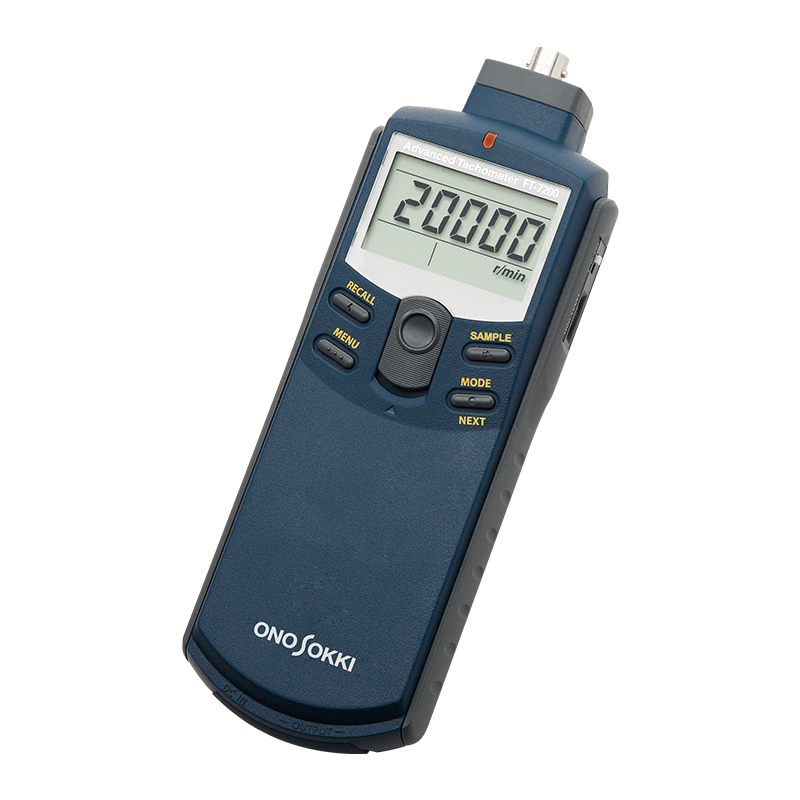
The FT-7200 Advanced Handy Tachometer is a user-friendly, highly functional, compact, handheld, high-performance Digital Tachometer. It measures rotational speed using FFT (Fast Fourier Transform) calculations from various signals such as noise, vibration, and magnetic flux changes generated by motors and other rotating machinery. Even with complex waveform signals from sound level meters and vibration sensors, it reliably extracts the frequency components corresponding to rotational speed using five measurement modes, and accurately calculates and displays the rotational speed.


The FT-7200 allows for easy measurement of rotational speeds, even for motors and other components already integrated into products where the rotating shaft is hidden and difficult to measure using conventional methods, by detecting sound and vibration. There is no longer a need to attach reflective marks to the object being measured or to perform special modifications to the rotating shaft, as was previously required. Furthermore, thanks to its new algorithm, the FT-7200 calculates and displays rotational speed with high responsiveness, even in the face of rapid changes in rotational speed such as motor start-up/fall-down and sudden acceleration/deceleration of engine speeds, which were previously difficult to track. Its battery-powered, handheld design makes it convenient to carry to measurement sites and allows for easy measurement.


As for compatible sensors (sold separately), you can choose from a wide range of detectors to suit your application, including microphones and sound level meters for sound detection, acceleration detectors and engine vibration detectors for vibration detection, and ignition pulse detectors for magnetic flux detection.


*We sincerely apologize, but please bring your own batteries.

Features

  • Compact, handheld type employing FFT calculation method

  • You can select the optimal algorithm from five different measurement modes.

  • Equipped with a tracking measurement algorithm capable of responding to rapid changes in rotational speed, such as startup and shutdown, as well as acceleration and deceleration.

  • Even if the axis of rotation is hidden, the rotation speed can be calculated and displayed from sound and vibration.

  • It is possible to measure the rotation of even the thin rotating shafts of small (micro) motors and the blades of fans without contact.

  • We offer a diverse lineup of sensors to cover a wide range of rotation measurement applications.

  • Includes analog output function and averaging function.

  • Backlit LCD, large numerical display

FT-7200 Demonstration Introduction Video (YouTube)

Fan rotation speed measurement (compared to HT-5500)

Specification

Depending on the measurement content, you can select a measurement algorithm from the following five modes.

Modes C, D, and E track acceleration and deceleration by processing internally at high speed. Mode C predicts the expected peak and calculates the rotational speed even when the maximum peak is lost. Mode D tracks the maximum peak, and Mode E can select the optimal rotational speed from up to 8 frequency peaks.

Measurement mode MODE Measurement algorithm
Constant rotation measurement
(This mode is effective when the rotation speed of the object being measured is constant.)
A Maximum Peak Frequency Method
B Frequency interval method
Rotational speed measurement (Active)
(This mode is effective when measuring the rotational speed of an object as it accelerates or decelerates.)
C Maximum peak frequency method (multi-order peak tracking)
D Maximum peak frequency method (peak tracking)
E Maximum peak frequency method (candidate rotation speed selection)

Maximum Peak Frequency Method

Maximum Peak Frequency Method

The calculation is performed at the frequency of the maximum peak in the power spectrum. This is the mode typically used for measurements.

Frequency interval method

Frequency interval method

This method involves sequentially determining the frequency intervals of each order component of rotation, and identifying the most frequently occurring frequency interval as the first-order component of the rotation speed to determine the rotation speed. This method is effective when the first-order peak is unstable.

Rotation speed candidate selection

Rotation speed candidate selection

The measurement focuses on any one power spectrum from among up to eight peak frequencies of power spectra.

Comparison of the FT-7200's new Mode C with previous models - Rotating bodies that could not be measured with previous models can now be measured with Mode C (left figure). Furthermore, the ability to track sudden acceleration and deceleration has also been improved (right figure).

  • Comparing analog outputs with an oscilloscope
    (Comparing analog outputs with an oscilloscope)
  • Motor rotation measurement
    Motor rotation measurement
  • Rotation measurement from vibration
    Rotation measurement from vibration
  • Rotation measurement from leakage magnetic flux
    Rotation measurement from leakage magnetic flux
  • Rotation measurement from a car's cigarette lighter socket
    Rotation measurement from a car's cigarette lighter socket
    (* The cigarette lighter socket sensor FT-0801 has been discontinued.)

Examples of engine speed measurement using microphones and vibration sensors

Examples of engine speed measurement using microphones and vibration sensors

This method allows you to measure engine speed from the sounds and vibrations caused by the movement of the engine pistons. It is useful when the engine compartment is covered and an engine speed sensor cannot be installed.
The pulse count sets the number of ignitions and explosions per crankshaft rotation.
(Example) In the case of a 4-stroke 4-cylinder engine, the number of pulses is 2P/R

Example of measuring the rotation speed of a DC motor incorporated into a household electrical appliance.

Example of measuring the rotation speed of a DC motor incorporated into a household electrical appliance.

This software measures the rotational speed of DC motors incorporated into household electrical appliances. For example, even in devices like electric toothbrushes that have a DC motor built inside, the rotational speed can be obtained from the magnetic flux leakage from the motor. Rotational speed can be measured simply by inputting the number of poles on the DC motor's rotor.

Example of rotation measurement using an engine rotation sensor

Example of rotation measurement using an engine rotation sensor

By clamping sensors to the primary low-voltage and secondary high-voltage wires of a vehicle, the engine's rotational speed can be obtained. Measurement can be performed simply by inputting the number of ignitions per revolution.
The pulse count sets the number of ignitions and explosions per rotation.

(Example) For a 4-stroke engine: When measuring on the primary side, set the value to half the number of cylinders. When measuring on the secondary side, set it to 0.5 P/R because there is one pulse for every two revolutions.

Example of measuring the rotation speed of a small fan using Accelerometer

Example of measuring the rotation speed of a small fan using Accelerometer

This device measures the rotational speed of rotating objects such as small fans. The vibration of a rotating object depends on its rotational motion. By measuring the frequency of the vibration, the rotational speed of the rotating object can be obtained.

Example of compressor rotation measurement using Accelerometer

ft7200-13

This device measures the rotational speed of compressors used in air conditioners and other devices. Even compressors with no visible rotation axis can have their rotational speed measured using the FT-7200 in combination with Accelerometer.

Example of measuring engine speed from muffler sound using a microphone.

Example of measuring engine speed from muffler sound using a microphone.

This system measures engine speed from the sound of a car's exhaust. Exhaust sound contains pulsating components caused by engine rotation. The engine speed can be measured from the frequency components of these pulsations. The pulse count is set to the number of ignitions and explosions per crankshaft rotation.
Depending on the performance of the muffler, measurement may not be possible.

Engine measurement using the cigarette lighter socket sensor FT-0801* (*The cigarette lighter socket sensor FT-0801 is no longer available for sale)

Engine measurement using the cigarette lighter socket sensor FT-0801* (*The cigarette lighter socket sensor FT-0801 is no longer available for sale)

It connects to the power outlet installed in automobiles and construction machinery. By detecting the ignition noise of the voltage output from the power outlet, the FT-7200 can measure the engine speed.

It supports battery voltages of 12V and 24V.

Measuring the rotational speed of the DC motor in an electric vehicle.

Measuring the rotational speed of the DC motor in an electric vehicle.

DC motors are used in a variety of fields, and in recent years, with their increasing use in electric vehicles, more accurate measurement of motor rotational speed has become crucial. Here, an OM-1200 electromagnetic induction detector is used, mounted perpendicular to the rotation axis of a DC motor to detect leakage flux from the DC motor, and the rotational speed is displayed on an FT-7200. The analog output can be used to record the changes in rotational speed with a recorder, and the monitor analog output can be used as a waveform confirmation signal.

Example of measuring the rotation of a centrifugal separator

Example of measuring the rotation of a centrifugal separator

Because the rotating shaft of a centrifuge is hidden inside, rotational measurement using reflective tape is not possible.
However, rotational measurement becomes possible by using the FT-7200 and Accelerometer. Accelerometer is attached to the lid of the centrifuge to detect vibration components that contribute to rotation.
The FT-7200 uses an FFT calculation method to enable stable rotational measurement.

Specifications List

Measurement section
Measured object DC motors, compressors, engines, or general rotating bodies
Arithmetic method FFT calculation method
Measurement time Within 250 ms
Input frequency range
2000 Hz range 30~2000 Hz(1,800~99,999 r/min)
500 Hz range 7.5~500 Hz(450~30,000 r/min)
250 Hz range 3.75~250 Hz(225~15,000 r/min)

However, in the case of 1 P/R

Unit of measurement r/min (rotational speed)
Measurement accuracy (r/min) ±2 × Rotational speed resolution (r/min) ± 1 count


*The accuracy of the rotation speed depends on the frequency range.

Minimum rotational speed resolution (r/min) Frequency range (Hz) ÷ 6400 × 60 ÷ Set pulse count (P/R)


*The resolution will be coarser when the rotation speed is accelerating or decelerating.
6400 = 200 lines × 32

Filter function Within the selected frequency range, limit the frequency range (rotational speed) you want to measure.
Averaging process Moving average processing
Average number of times: OFF, 2, 4, 8, 16
Sensor amplifier sensitivity adjustment volume The sensor amplifier sensitivity can be adjusted using the rotary volume control on the right side of the unit.
Detection unit
Compatible sensors
Engine rotation OM-1200/OM-1500IP-292、IP-296IP-3000AIP-3100、FT-0801*
vibration VP-202, VP-1220, NP-2000 series, NP-3000 series
sound MI-1433/MI-1235 (microphone) + MI-3111 (Microphone Preamplifier)
others FT-0501+FT-0150

*Depending on the type of engine and object being measured, detection may not be performed correctly.
* FT-0801: Discontinued

Voltage level 5 V:Max ± 5 V
0.5 V:Max ± 0.5 V
0.05 V:Max ± 0.05 V
Input Coupling AC coupled
Power supply for NP sensors Constant current power supply (2.4 ± 0.5 mA)
Display section
Number of display digits 5 digits
Character height 10.2 mm
Display LCD 7-segment, with backlight
Display update time 0.5 ± 0.2 seconds
Display resolution 1 r/min
Measurement mode section
CNS(Constant) Modes A and B: Used when the rotational speed of the object being measured does not fluctuate much (e.g., when measuring the rated rotational speed).
ACT(Active) Modes C, D, and E: Used when the rotational speed of the object being measured is accelerating or decelerating (however, accurate measurement may not be possible when the change is sudden).
Analog output section
【REVO】Analog Output
Output content Output relative to the displayed rotation speed value
Voltage range 0 to 1 V / 0 to FS (FS can be set arbitrarily)
Conversion method 10-bit D/A conversion method
Linear number ±1 % of F.S.
Output update time Within 250 ms
Temperature stability ±0.05 % of F.S./ ℃(Zero & Span)
Setting error ±0.5% of FS (Factory Setting Error, Zero & Span)
Load resistance 100 kΩ or more
Output connector Mini jack (Φ2.5)
【SIG】Analog output for monitoring
Output content Analog output for monitoring after waveform shaping of the sensor signal.
Load resistance 100 kΩ or more
Output connector Mini-to-mini jack (Φ2.5 / shared with REVO output)
Pulse output section
Signal content Frequency pulses of the power spectrum extracted by FFT processing
Output voltage Lo: 0.5 V or less, Hi: 4.5 V or more (at no load)
Output update time Constant rotation mode: within 500 ms
Rotational acceleration/deceleration mode (Active): within 250 ms
Load resistance 100 kΩ or more
Output connector Mini-to-mini jack (Φ2.5 / shared with REVO output)
General specifications
Power supply AAA batteries * 4 batteries, or the PB-7090 dedicated AC adapter (optional)
Continuous use time Approximately 6 hours (with backlight off)
Approximately 5 hours (with backlight ON)
(Using alkaline batteries, at 20°C, excluding when using the NP sensor (*1))

(*1) When using NP sensors, the current consumption will be high due to the constant current power supply, so we recommend using a dedicated AC adapter.

Battery LOW indicator Lights up at approximately 4.2V
Operating temperature range 0~+40 ℃
Storage temperature range −10℃~+50 ℃
Operating humidity range +35~+85% RH (no condensation)
Storage humidity range +35~+85% RH (no condensation)
Outline drawings 180.5 (L) × 66 (W) × 47.5 (D) mm (main unit only)
Weight Approximately 280g
Compliance standards (CE marking)
Low Voltage (LVD) Directive 2014/35/EU Standard EN 61010-1
EMC directive 2014/30/EU Standard EN 61326-1
RoHS Directive 2011/65/EU Standard EN IEC 63000
 
Accessories Carrying case, 3 instruction manuals
price  

*Please provide your own batteries.

Option

Links to detailed product and service information.

Ignition detector
(For primary side)
IP-292
Ignition detector
(For secondary side)
IP-296
Engine rotation sensor
IP-3000A


Engine rotation sensor
IP-3100
Ignition detector (for primary side) IP-292 Ignition detector (for secondary side) IP-296 Engine speed detector IP-3000A Engine rotation detector IP-3100
       
Ignition pulse detector
OM-1200
Ignition pulse detector
OM-1500
Rotation detector for DC motor
FT-0501
Piezoelectric Accelerometer
NP-2000 series
NP-3000 series
Ignition pulse detector OM-1200 Ignition pulse detector OM-1500 DC motor rotation detector FT-0501 Piezoelectric Accelerometer NP-2000 series, NP-3000 series

* A separate charge amplifier is required when using the NP-2000 series.

       
Engine rotation sensor
VP-202
Engine rotation sensor
(High-sensitivity type)
VP-1220
Cigarette lighter socket sensor
FT-0801 discontinued.
Microphone + Preamplifier
MI Series
Engine rotation sensor VP-202 Engine rotation sensor (high-sensitivity type) VP-1220 (High-sensitivity type) VP-1220 Cigarette lighter socket sensor FT-0801 (Discontinued)

Input voltage: 12V, 24V
Cable length: 2 m
Connector: BNC

Microphone + Preamp MI Series

* Low-noise microphone
MI-1282M10 is not supported.

       
Magnetic stand
+ Stand jig
HT-0522+HT-0521B
AC adapter
PB-7090
Signal cable (2m)
AX-501
 
ft7200-24 ft7200-25

Input: AC 100-240V
Output: DC 5.9 V / 3.5 A
(The included AC cable is
(for AC100~120V)

ft7200-26

Analog and pulse output compatible
Φ2.5 pin plug to CO2 type (BNC)

 
HT-0522
HT-0521B
     

最終更新日:2025/04/10