Skip to content

Select your region & language

Global

Region

Angle axis signal measurement software
Made to order
ExAngle

Combustion analysis software that enables an efficient development environment

ExAngle is a redesigned version of our long-cultivated combustion analysis measurement technology, reborn not only for internal combustion engines but also as a versatile high-speed sample measuring instrument for all rotating bodies.

EX-4100 ExAngle

This is basic software that uses a 1MHz high-speed unit for combustion analysis and can record with a minimum resolution of 0.05°. It includes the following measurement functions equivalent to previous products.

  • DS-0328T Transient Measurement

  • DS-0335 SYNC measurement

  • DS-0349 Pulse period measurement

  • DS-0360 Encoder-less measurement

EX-0428 DS Combustion Analysis Function

This software includes all the calculation functions of the following older products, such as the illustrated mean effective pressure, combustion mass ratio, combustion fluctuation rate, knocking peak, combustion noise, and torque.

  • DS-0328 Combustion Analysis

  • DS-0337 Combustion Noise Analysis

  • DS-0329 Knocking Analysis

  • DS-0361 Torque Fluctuation Analysis

EX-0436 DS Combustion Link Function

ExAngle can be controlled from the bench system via LAN communication. This enables recording commands and data transmission/reception.

EX-0483 CAN function

ExAngle can send calculation results to the CAN bus, or receive and record CAN information from the vehicle.

EX-0439 Knock Expert function

By measuring engine noise using a microphone, knocking can be quantitatively quantified.

For customers using the conventional combustion analysis software (DS-0328):

Depending on when you initially purchased your DS-3000 series hardware (products shipped between 2012 and 2016), a firmware update may be required. In that case, we will take your DS-3000 series hardware back and perform the update at our facility. For details, please contact our sales office or your nearest dealer.

New features

Network License NEW

We now offer a new network license version (floating license). By inserting a dedicated USB license key into the server PC, client PCs on the same network can use the software. For pricing and specifications, please contact our sales office or your nearest dealer.
Operating environment (server PC): Windows Server 2022, Windows Server 2025

  • Network License
Note
  • To use a network license, a dedicated USB license key is required. Simply inserting the USB license key into the server PC will not enable the network license functionality.

  • The network license version is only available for offline analysis.

  • For use overseas, please contact our sales office or your nearest dealer.

Features

  • It can be used not only as a "dedicated" combustion analysis instrument, but also as a more general-purpose high-speed angle sample measuring instrument.

  • The NonStop architecture overcomes the weakness of monitors freezing, enabling continuous monitoring even in hazardous testing environments.

  • In addition to the main recording, a sub-recording system can operate simultaneously, ensuring that even unexpected phenomena are not missed.

  • The intuitive GUI reduces human error by test takers. It is also useful for outsourcing testing operations and expanding overseas.

Example of a combustion analysis system configuration

  • Example of a combustion analysis system configuration

Example Use: Enhanced monitoring capabilities for new fuel tests with NonStop monitor + sub-recording.

To achieve carbon neutrality, the evaluation and verification of new fuels and devices is becoming increasingly important. With ExAngle, testing can be conducted safely and efficiently even with limited development resources.

  • Example Use: Enhanced monitoring capabilities for new fuel tests with NonStop monitor + sub-recording.

ExAngle ensures continuous monitoring during data acquisition, calculations, and file saving, allowing testers to perform their tasks without worry. Furthermore, it allows for parallel execution of sub-acquisitions for anomaly monitoring alongside the main acquisition, enabling the preservation of valuable anomaly data while protecting the equipment.

Allowable rotation speed and maximum number of recording cycles

High speed CH
Number of uses
Angular resolution [°]
1.00 0.50 0.25 0.10 0.05
r/min cycle r/min cycle r/min cycle r/min cycle r/min cycle
1 30,000 100,000 30,000 100,000 30,000 100,000 16,000 40,000 8,000 20,000
4 30,000 100,000 30,000 50,000 26,500 25,000 12,300 10,000 6,000 5,000
8 30,000 50,000 29,000 25,000 18,000 12,500 8,000 5,000 4,000 2,500
12 30,000 30,000 22,500 15,000 12,800 7,500 5,700 3,000 2,800 1,500
16 29,000 20,000 18,000 10,000 10,000 5,000 4,300 2,000 2,200 1,000
20 24,000 20,000 14,700 10,000 8,200 5,000 3,500 2,000 1,800 1,000
24 21,000 10,000 12,800 5,000 7,000 2,500 2,800 1,000 1,500 500
28 18,000 10,000 10,800 5,000 5,700 2,500 2,400 1,000 1,200 500

System Configurations

  • System Configurations

Specification

DS-0380 4-channel high-speed A/D unit for combustion

Number of input channels 4 channels per unit (maximum 28 channels, up to 5 units)
Input method Single-ended
Isolation Unit-to-unit isolation (four inputs within a unit share a common ground)
Terminal shape BNC terminal
Input Impedance 1 MΩ
Coupling DC coupled
Input voltage range ±0.1/0.2/0.5/1.0/2.0/5.0/10.0V
Level Monitor LED -20 dB (green), -0.915 dB (red)
Offset error Within ±1.0%
A/D resolution 16-bit sequential conversion type
Sampling rate up to 1MHz
Data memory 56 MB/ch
Weight Approximately 900g

DS-0378 Combustion Pulse Input Unit

Pulse input section

Input Impedance 100 kΩ
Input method Single-ended
Isolation Non-insulated
Terminal shape BNC terminal
Coupling AC or DC coupling
Input voltage range ±10 V
Absolute Maximum Input Voltage ±45 V
Minimum input voltage 1.0 Vp-p
Monitor LED Signal normal detected (green), signal abnormal (red)
Trigger level ±10 V, setting resolution 10 bits
Trigger Slope + (rising point), - (falling point)

insulation

insulation "1 P/R input, angle pulse input", "external start input"
"Status output" isolation (1 P/R and angle pulse are common to all).

External Start Input

Input format TTL or voltage-free contact signal
Internal pull-up resistor Connected to the internal +5V via a 100 kΩ resistor.
Minimum pulse width 10 ms

Status output

Output format TTL
External Start Function Unit BNC input terminal for starting measurement with TTL level or voltage-free contact signal.
The detected slope is either rising or falling.
Weight Approximately 800g

DS-0381 16-channel low-speed A/D unit for combustion

Number of input channels 16 channels per unit (maximum 32 channels, up to 2 units)
Input method Single-ended
Isolation Non-insulated
Terminal shape D-SUB 37pin
Input Impedance 1 MΩ
Coupling DC coupled
電圧レンジ ±1.0/2.0/5.0/10.0 V
A/D resolution 16 bit
Sampling angle 45°
Sample method Multiplex system
Weight Approximately 800g
Accessories BNC connector box, signal cable (1.5 m)

DS-0382 16-channel D/A converter unit for combustion

This unit outputs combustion analysis calculation data (Pi, Pmax, etc.) as analog data. Each unit consists of 16 channels, and can be expanded up to a maximum of 32 channels.

Number of output channels 16 channels per unit (maximum 32 channels, up to 2 units)
Output method Single-ended (common GND for each channel)
Isolation Non-insulated
Terminal shape D-SUB 37-pin (using an external BNC connector box)
Output Impedance 1 Ω or less
Load impedance 10 kΩ or more
Maximum Output Current ±1 mA
Output coupling DC coupled
Output voltage range ±10.0 V
D/A resolution 14 bit
Startup time Less than 100 μs (10% to 90% of the time it takes for the voltage to change from -10 V to +10 V)
Weight Approximately 800g
Accessories BNC connector box, signal cable (1.5 m)

DS-3284 Combustion Analysis Unit

AC power supply voltage 100-240 VAC
Milk power supply voltage 10.5–16.5 V *1
Power consumption Approximately 27-67 W *2
Operating temperature range 0 to +40°C (non-condensing)
Storage temperature range -10 to +60°C
CE marking correspondence
Maximum Number of Units 9 units
PC Interface USB 3.0 interface
Outline drawings 257 (W) x 104 - 344 (H) x 182 (D) mm *2
Weight Approximately 3.1–8.5 kg *2

Hardware configuration supplement: For 5 units or more, a 150W AC adapter will be used, and a cooling fan will be included.
*1: The voltage will be 10.5-16.5V only when using 4 units.
*2: Varies depending on the number of units.

Option

EX-0428 DS Combustion Analysis Function

The combustion calculation results are monitored in real time. The recorded data files can be analyzed, and the results can be output as text files.

Easy-to-use software

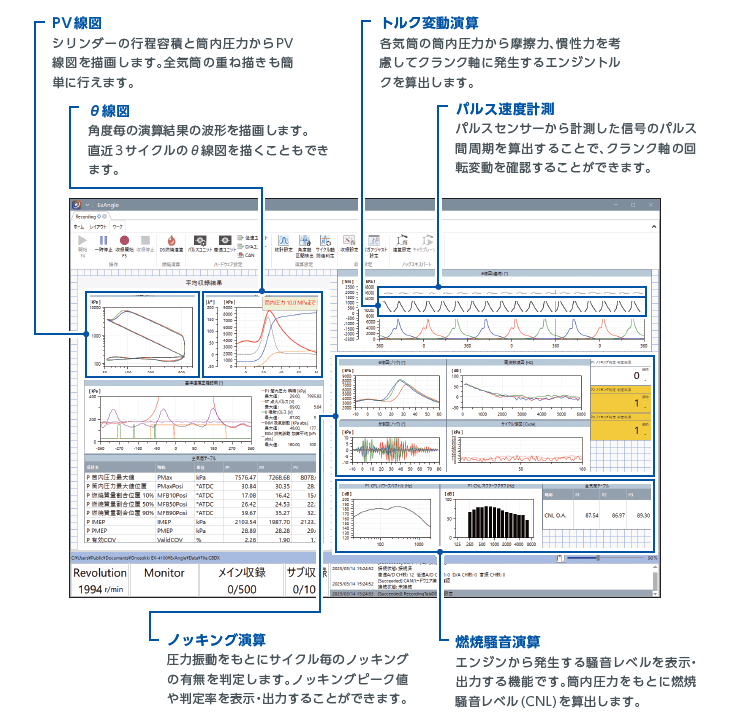
θ diagram

This displays the waveform of the calculation result for each angle. You can also draw the theta diagram for the most recent three cycles.

PV diagram

The PV diagram is drawn from the cylinder stroke volume and in-cylinder pressure. Overlaying diagrams of all cylinders is also easy.

Pulse velocity measurement

By calculating the inter-pulse period of the signal measured from the pulse sensor, it is possible to check the rotational fluctuations of the crankshaft.

Torque fluctuation calculation

The engine torque generated at the crankshaft is calculated by considering friction and inertia forces from the in-cylinder pressure of each cylinder.

Knocking operation

The system determines the presence or absence of knocking in each cycle based on pressure oscillations. It can display and output the knocking peak value and detection rate.

Combustion noise calculation

This function displays and outputs the noise level generated by the engine. It calculates the combustion noise level (CNL) based on the in-cylinder pressure.

  • Easy-to-use software

Function

Combustion analysis

By inputting crank angle pulses (1 P/R, 360 P/R) to the DS-0378 pulse unit and in-cylinder pressure to the DS-0380 high-speed A/D unit, it is possible to perform combustion calculations using angle sampling from the in-cylinder pressure.

External trigger input

By inputting voltage signals to the DS-0378 pulse unit to start and stop ExAngle recording, simultaneous recording with other measuring instruments can be achieved.

Status out

The DS-0378 pulse unit outputs 0-5V in sync with the ExAngle recording timing. This allows you to notify other measuring instruments of the start of ExAngle recording.

Low-speed analog input

The DS-0381 16-channel low-speed A/D unit allows for the measurement of analog data for each cycle. The measured values can also be used as parameters for combustion calculations.

Analog output

The DS-0382 16-channel DA unit outputs the results of each cycle calculated by ExAngle as voltage values.

System configuration example
  • System configuration example
Measurement is possible without installing a crank angle sensor.

It is possible to use the control-type missing tooth signals located inside the automotive ECU as rotation signals and sample them. This is a convenient function when it is difficult to install a crank angle sensor or when taking measurements on an actual vehicle.

Example of settings screen
  • Example of settings screen

EX-0436 DS Combustion Link Function

This feature allows you to remotely control ExAngle from your benchmark system using Windows socket communication capabilities.
This enables the automation of routine testing.

  • Data communication via LAN connection (TCP/IP socket)

  • By issuing a recording start command from the bench system, it is possible to simultaneously record performance data and combustion analysis data.

  • It is possible to save ExAngle data files (*.CBDX) and text files (*.CSV) with the same name as the performance data.

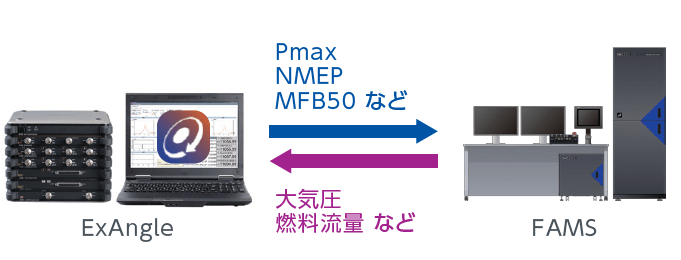
  • It is possible to incorporate performance data (such as atmospheric pressure and fuel flow rate) into the parameters used for combustion calculations.

Example of linking with our measurement and control system FAMS-R6
  • Example of linking with our measurement and control system FAMS-R6

Note 1: The FAMS-R6 requires the IS-0207 DS Link function option to be installed.
Note 2: Cannot be connected to FAMS-8000.

EX-0438 CAN function

This function enables CAN communication. It is less susceptible to external noise and reduces wiring complexity by significantly reducing the number of signal lines.

CAN Input: Results can be recorded for each cycle. If you set atmospheric pressure, fuel flow rate, etc., these can be reflected as specification values.
CAN Output: ExAngle can output the results of each cycle calculated by the program (Pmax, NMEP, etc.).
* Compatible hardware: VN1610 (manufactured by Vector Inc.)

System configuration example
  • System configuration example

EX-0439 Knock Expert function

Engine knocking is detected from engine sound measured by a microphone. Knocking calculations are processed in real time, without missing any cycles. The knocking calculation results can be displayed on the calculation monitor, trend display, etc., and can also be output to the DS-0382 16-channel D/A unit or via CAN.

System configuration example
  • System configuration example

By extracting data from the microphone's time-series data according to the processing angle range of each cylinder, it is possible to perform knock calculations simultaneously for up to four cylinders with a single microphone. There is no need to install in-cylinder pressure sensors on all four cylinders.

  • EX-0439 Knock Expert function

Operating environment

OS Microsoft® Windows® 10 Pro
Microsoft® Windows® 11 Pro
For detailed version information, please refer to the Software Environment [Windows] section.
CPU Intel® Core™ i7 8th generation and later processors
Base clock frequency 1.7GHz or higher
memory 16GB or more (32GB recommended for high-speed 12CH or higher)
drive DVD optical drive (required for software installation)
Interface USB Type-A USB 3.0 x 3 or more ports
(A LAN port is also required when using EX-0436)
display Full HD 1920 x 1080

* Microsoft® Windows® is a registered trademark of Microsoft Corporation in the United States and other countries.
Other company and product names mentioned are trademarks or registered trademarks of their respective companies.

Crank angle measuring device (optional)

  • Optical fiber crank angle detector CP-5110B, slit disc CP-5120/5130, and crank angle amplifier CA-6000B

  • Optical fiber crank angle detector CP-5730 (slit disc and detector integrated) and crank angle amplifier CA-6000B

Crank Angle Detector
Slit disc separation type
CP-5110B
Crank Angle Detector
Slit disc integrated type
CP-5730
For crank angle detector
amplifier
CA-6000B
Crank Angle Detector, Slit Disc Separation Type CP-5110B Crank Angle Detector, Integrated Slit Disc Type, CP-5730 Crank Angle Detector Amplifier CA-6000B
  • High noise immunity thanks to the use of optical fiber.
  • Improved optics enable stable detection.
  • Small, lightweight, and usable even with high-vibration engines.
  • Designed with setup in mind.
  • Light rotational load with no bearings used.
  • High noise immunity thanks to the use of optical fiber.
  • Improved optics enable stable detection.
  • Improved vibration resistance through weight reduction of rotating parts and improved rotation stopper structure.
  • Smooth rotation thanks to high-speed bearings.
  • The system receives signals from the crank angle detector (A phase: angle signal, 1 P/R: origin signal) and outputs them as TTL level or analog signals.
  • External volume control allows for matching of crank angle and detector sensitivity.
  • High noise immunity equivalent to CE marking
  • The crank angle detector can also be changed by switching a switch.

最終更新日:2026/1/20